


It’s been a while since we’ve gone through a round-up of some of my physical media treasures, hey? Between going on vacation and taking on some new projects, my writing has slowed down a bit here at Rewind and Revive. That being said, by a sheer stroke of luck, everything I’ve been consuming cinematically lately has been absolutely delicious. Whenever that happens, I feel the urge to lean into a bit of exploratory play — whether that took the form of my Robert Hossein essay from February or last month’s review of Kin-dza-dza!. Nevertheless, as my physical media stack grows, it’s getting to the point where covering them in a timely manner feels like a game of whack-a-mole.
For today’s round-up, I initially had planned to come to you with five reviews, though as I watched the first three films, I realized that I already had too much to say, and, more importantly, I had a sudden “Eureka!” moment while thinking about them in conversation with one another. Hear me out, because I know that, on paper, grouping a classic Greek tragedy, a 1970s Korean psychological drama, and a movie about an ‘80s teen girl punk band together sounds mad.
What struck me about these three films is the shared tension they carry, though presented in completely different ways. Each film follows a woman as she navigates forces that attempt to define her — whether through expectation, perception, or performance. While there is no neat resolution across any of these stories, there is something to be said for recognizing how identity shifts under those conditions. Just… noticing those forces at play, and what it means to move within them.
Even for a round-up format, I wanted to let these three titles breathe. The following films stayed with me, and I hope they give you something to think about, too.
Let’s rewind and revive.

Iphigenia (Michael Cacoyannis; 1977)
At one point in Michael Cacoyannis’ Iphigenia, King Agamemnon’s wife, Clytemnestra (Irene Papas), tells her husband (Kostas Kazakos), “Your silence is enough,” after she discovers his cruel secret. It’s a moment that comes well into the film’s 129-minute runtime, but it speaks to what Cacoyannis does so well throughout: showing us the truth well before anyone says it out loud.
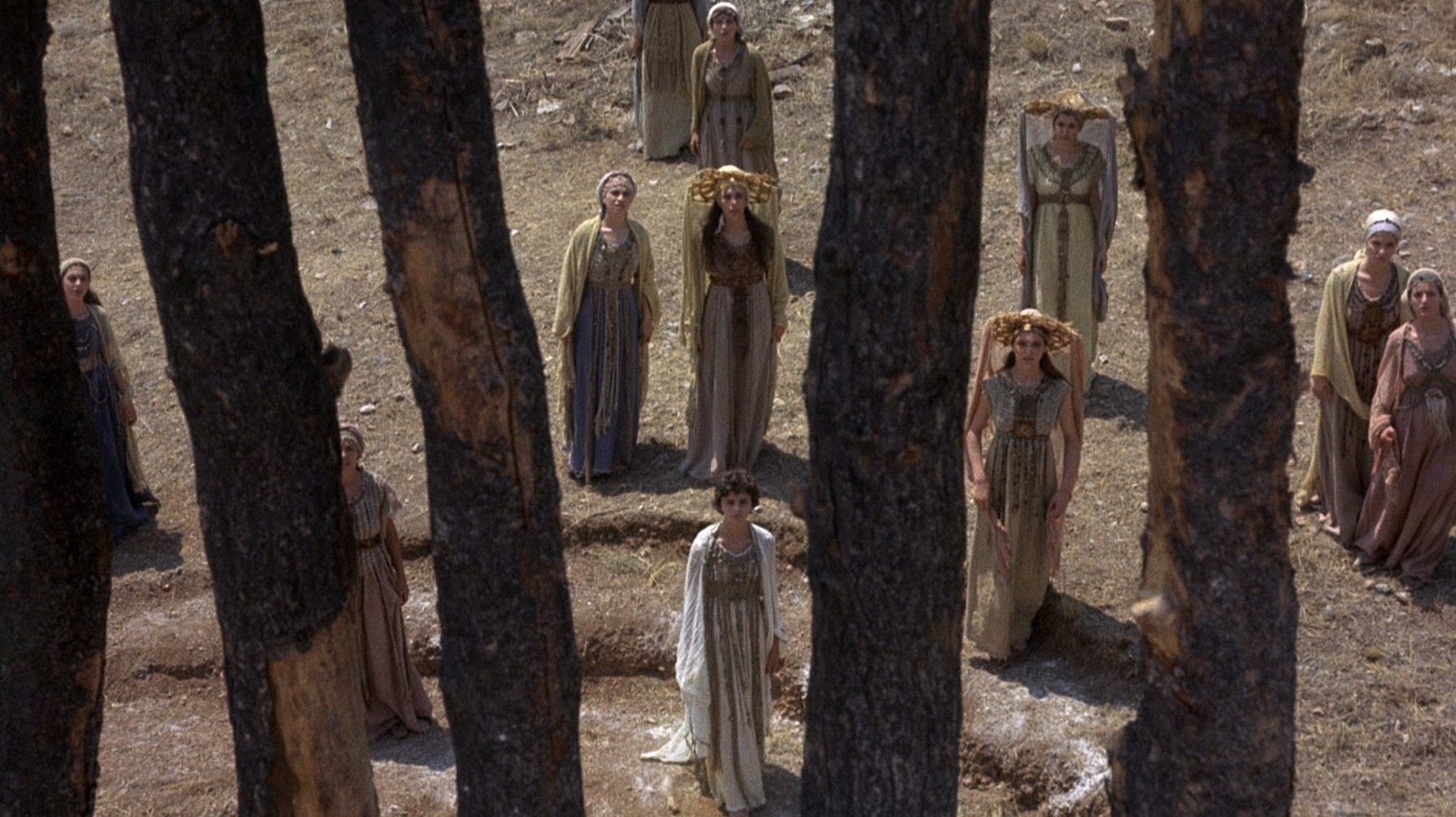
What surprised me most about this Euripidean tragedy is how much time we spend waiting. Immediately through Giorgos Arvanitis’ patient cinematography, we’re shown the Greek army halted at Aulis, stalled by windless skies. Their tempers are rising — as is the temperature itself — and you can practically feel the suffocating heat.
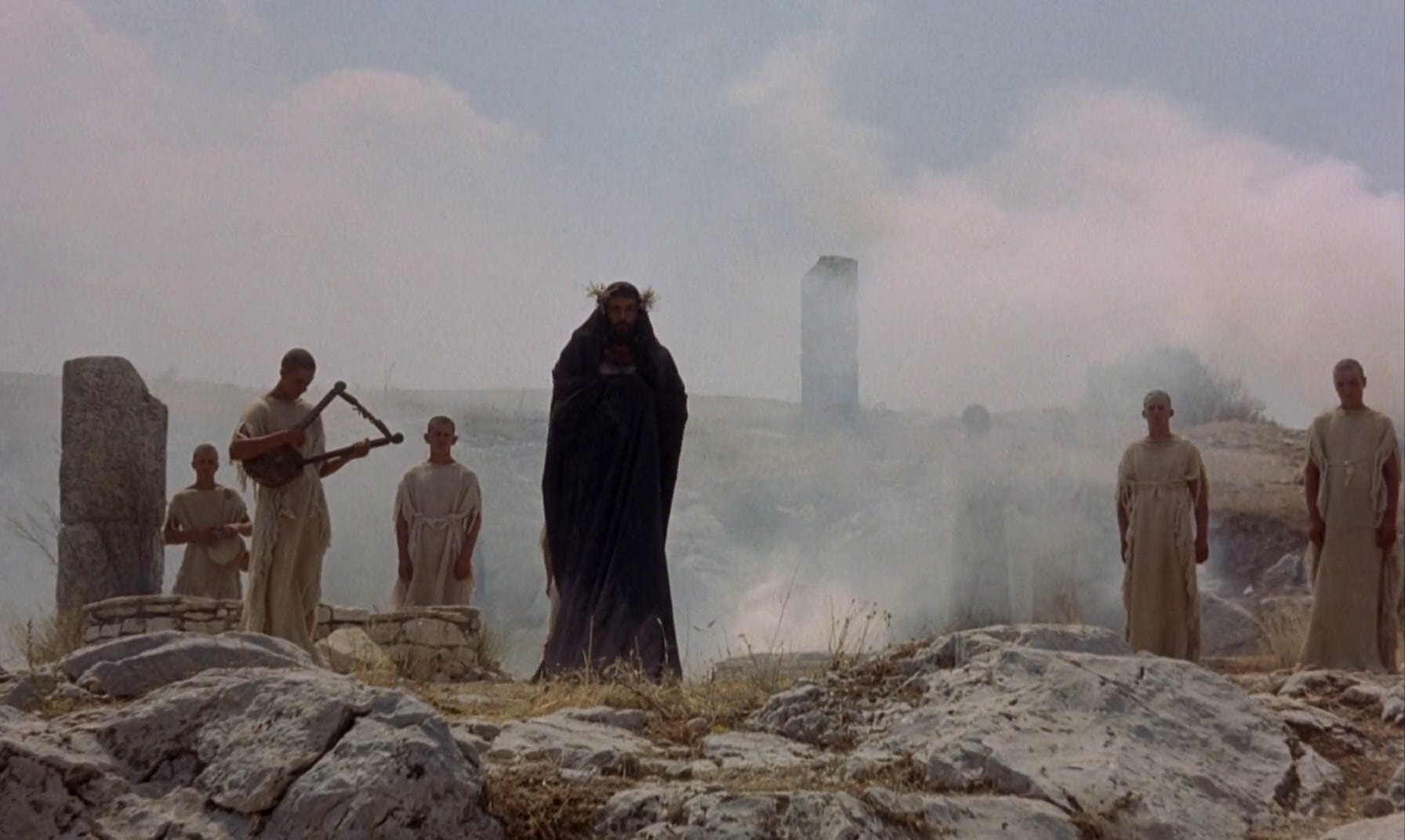
Agamemnon’s men are restless, so he allows them the thrill of the hunt at the nearby temple of Artemis, though, as he warns, no deer should be harmed. After the inevitable happens, we don’t even have to wait for the oracle’s demand to arrive by word of mouth; Agamemnon’s fate is instantly sealed. Arvanitis cuts to a gorgeous but ominous shot of the temple’s high priest, Calchas (Dimitris Aronis), elevated almost in a ritualistic tableau. Flanked by torchbearers against the pale sky and jagged stones, the composition feels like the gods announcing their divine judgment.
When Iphigenia (Tatiana Papamoschou) is finally named as the sacrifice, it lands to us as mere confirmation. For Agamemnon, it’s the same confirmation, though one he refuses to face, his expression contorting in agony. The divine machinery has already begun moving, and it will only stop at the cost of the very cause he claims to serve. As he later tells Iphigenia herself, “Greece is more powerful than both of us.”
In an archival 1977 interview with Cacoyannis and Papas for French television (included on the Radiance disc extras), the filmmaker mentioned that Euripides often dealt with the “corruption of war” — something he claimed he resonated with because “it’s exactly like current events.” In Iphigenia, the army becomes the living chorus, or as Agamemnon calls it, the “thousand-headed monster” that he cannot escape. Crushed between the love for his child and public expectation at the brink of cannibalization, he convinces himself that he has no other choice.
“The film was screaming out to have this physicality to it,” Cacoyannis shared during Cannes press coverage following the film’s release. By taking the first 20 minutes to ground us in the suffering of Agamemnon’s people, the simmering anticipation only drives the tragedy home more forcefully later on.
If Agamemnon embodies the paralysis of a man crushed by the system, Clytemnestra becomes its fiercest opponent. For a film built on the tension of waiting, her fury doesn’t arrive out of nowhere — it, too, simmers. Early on, before she realizes the truth, she draws a clear boundary between public power and private life, telling her husband, “The world is your dominion, so rule it! But in my household, I’m the ruler.” Initially, the line feels like bold defiance, but in hindsight, it reveals that Clytemnestra refuses to fall in line, even before she knows what she’s being asked to accept.
When Clytemnestra discovers her daughter’s fate, there’s no illusion left to maintain. She sees through Agamemnon completely, viciously cutting through every excuse he has tried to construct — or, better yet, saying aloud what the film has already shown us.
Iphigenia, on the other hand, undergoes the quietest transformation of all, yet perhaps the most unsettling. As she’s surrounded by the wails of her mother’s resistance and her father’s rationalizations, she simply… absorbs it all, turning it into something she can believe. “My weddings. My children. My glory.”
You can purchase Iphigenia via Radiance Films or MVD Shop.

Splendid Outing (Kim Soo-yong; 1978)
For a moment, Kim Soo-yong’s Splendid Outing tricks us into thinking we are moving toward a familiar image of power. It opens with a car driving from a mansion toward an imposing skyscraper in Seoul, before cutting to a first-person POV as the camera glides through hallways, past deferential figures, and into an office. When the person behind the desk is finally shown, it’s President Gong Do-hee (played brilliantly by Yoon Jeong-hee), a woman who appears completely in charge of her corporate empire. She remains composed and confident as she moves through a series of meetings, including a conference on the feminist movement in South Korea. As she approaches the stage, the camera suddenly goes out of focus — the first hint of the unraveling to come — but she nonetheless boldly declares, “The era of men symbolizing power has come to an end. All forms of power must yield before wisdom and intelligence.”
Shortly after, the film starts to shift its gaze. At a congratulatory gala that same afternoon, various men approach her with praise. However, their remarks are laced with subtle condescension, even noting that she chose to remain single after her husband’s death. Gong brushes off the comments with practiced ease, though this exchange also suggests that her authority is something she must continually assert — instead of something that would simply be granted to her if she were a man.
That same night, Gong retires to her bedroom, exhausted. Jung Il-sung’s cinematography adopts a surreal tone, enveloping her space in a blue glow as the score turns ominous, complete with spectral crooning. As dream sequences begin to blur with flashbacks of the “jokes” made at her expense earlier in the day, the composure she has maintained cracks, revealing the emotional strain that her carefully constructed image cannot contain for much longer.

The following day, after visiting a shaman who offers insight into her dream, Gong sets off on her “splendid outing,” this time, driving herself to a small seaside town. From this point on, the film descends into a nightmare, her sense of control erased under increasingly hostile conditions. Faces crowd the frame through fisheye lenses, bodies press in from all sides, their screaming voices suffocating her. It is within this disorientation that Gong is taken to an isolated island and finds herself trapped with a man who insists that she is his wife.
Released in 1978, the film managed to slip past strict censorship while still carrying its underlying critique. At first glance, Splendid Outing appears abstract, but as Gong’s sense of self continues to fracture, it’s the society she inhabits that comes into sharper focus.
What’s most unsettling is the suggestion that Gong’s sense of self was never as stable as it first appeared — it was only holding its shape at a distance.
You can purchase Splendid Outing via Radiance Films or MVD Shop.

Ladies and Gentlemen, The Fabulous Stains (Lou Adler; 1982)
For most of its runtime, Ladies and Gentlemen, The Fabulous Stains feels like a film about crafting an image. What’s harder to track — and something I’m still torn on — is the moment that image stops belonging to the person who made it.
Corrine Burns (15-year-old Diane Lane, alongside an equally young Laura Dern!) seems to understand the weight that an image can carry from the moment we meet her. Fake it till you make it, right? Even before she dons her signature black and red eyeliner and skunk hair, she carries herself with a defiant energy that’s both sarcastic and restless. Watching her give an early interview, where she casually applies makeup mid-conversation while plugging her band’s name, instantly brought a smile to my face. Sure, we soon find out that they can barely play (their first performance was borderline painful to watch), but it doesn’t seem to matter. What Corrine has instinctively is attitude, and, well, that’s sometimes enough to get people looking.
After the Stains’ disastrous first performance, her bandmates (Dern and Marin Kanter) look visibly uncomfortable, but Corrine holds her ground, ripping off her jacket and beret before turning on the audience itself. As she heckles them and screams that she’s perfect, you can’t help but sneer with her. Soon enough, after an incident on tour is picked up by a local news segment that interviews Corrine (complete with her own carefully shaped version of events), the Stains return to the stage to a packed crowd — and an audience decked out to look just like her. This collective, unapologetic confidence is infectious (hell, I even wanted to be swept up in it all). In a follow-up segment, the male reporter dismisses it all as a mere passing spectacle, while the female reporter leans into the sense of female empowerment. Regardless of how it’s framed, the effect is the same: the Stains have gone from being watched to being reproduced.
As Corrine leans further into the persona — even swiping Billy’s (Ray Winstone) song and performing it with her band — the line between performance and authenticity begins to blur in a different way, and it doesn’t help that the very machinery that built the Stains is just as quick to turn on them. Billy won’t let The Looters be pushed aside so easily, so when he finally calls Corrine out as a phony in front of her fans, the very crowd that so eagerly adored her recoils instantly. What was once seen as raw and unfiltered has been churned and spat out into something hollow.

It’s at this point that I was expecting to see some seeds of growth take root — not a tidy resolution, but something that’s less… flat. What follows is an ending that left me conflicted, precisely because it suggests a version of Corrine that seems strangely out of step, or, more accurately, one that doesn’t fully belong to her. Perhaps most frustrating is that the tension extends beyond the film itself. While The Fabulous Stains is directed by Lou Adler, its original script — written by Nancy Dowd with input from punk journalist Caroline Coon — reportedly ended very differently, before being reshaped in such a way that ultimately sacked its creators. In that sense, the aspect that bothers me about the film also makes for a strangely fitting conclusion: it becomes the very thing it’s been circling all along – an image no longer in control of the person who created it.
All of this to say, despite the uneasy landing, the film’s energy has moments that do resonate. Lane is already radiating star power (as is a spectacular but quiet early scene with Dern), while Corrine’s aunt (Christine Lahti) delivers an incredibly heartfelt monologue after the Stains’ early success, sharing the pride she feels in seeing her daughter and nieces escape their small-town existence. More than anything, though, it’s the lasting influence of the Stains themselves, which, fittingly, outgrew the film that first contained them, finding a new life years later on late-night television among up-and-coming musicians and audiences who saw something real in its imperfect defiance. “We don’t put out!”
I love how you connected these three films thematically. It's a triple feature I'm going to make happen.