


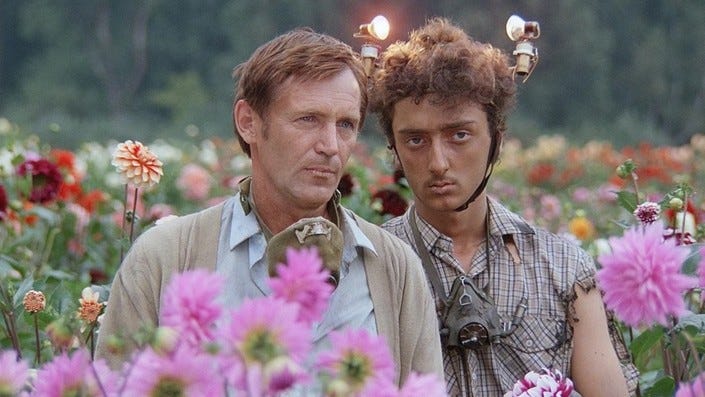
Do you ever stop and wonder how much time passes before the absurd becomes merely routine? It’s a curious exercise to keep in mind as you watch Georgiy Daneliya’s 1986 satirical sci-fi, Kin-dza-dza!.
The first few scenes of the film feel deliberately disorienting. After presenting us with opening credits over a desolate landscape of rock and sand, we’re suddenly jolted into 1980s Moscow. The camera cuts, adopting an intrusive handheld approach as we meet the Russian construction foreman, Vladimir (Stanislav Lyubshin) a.k.a. ‘Uncle Vova’ in his family home. After his wife sends him on a mission to obtain some macaroni, Vladimir runs into Gedevan (Levan Gabriadze), a Georgian student carrying a violin, who urges him to come help speak to a strange, lost man in shabby clothing. Claiming to hold a teleportation device, Vladimir tests it with the push of a button, and, with the same, jarring cut, we’ve arrived on the planet Pluke, in the galaxy of Kin-dza-dza. Soon enough, it becomes clear that for a society brandishing such advanced technology, survival depends on mastering a set of bizarre rituals.
I had known a little bit about Kin-dza-dza! through word of mouth, and was immediately intrigued by its premise. Elements of Daneliya’s film brought Karen Shakhnazarov’s Zerograd (1988) to mind, a film that, though not science fiction, delights in the same bureaucratic absurdity; operating within a world with rules that seem logical to everyone inside the system, but completely irrational to an outsider. It’s a particular sort of late-Soviet tone where humor and dread are squished together on a loveseat. The absurd isn’t the joke here; it’s that everyone keeps participating in it.
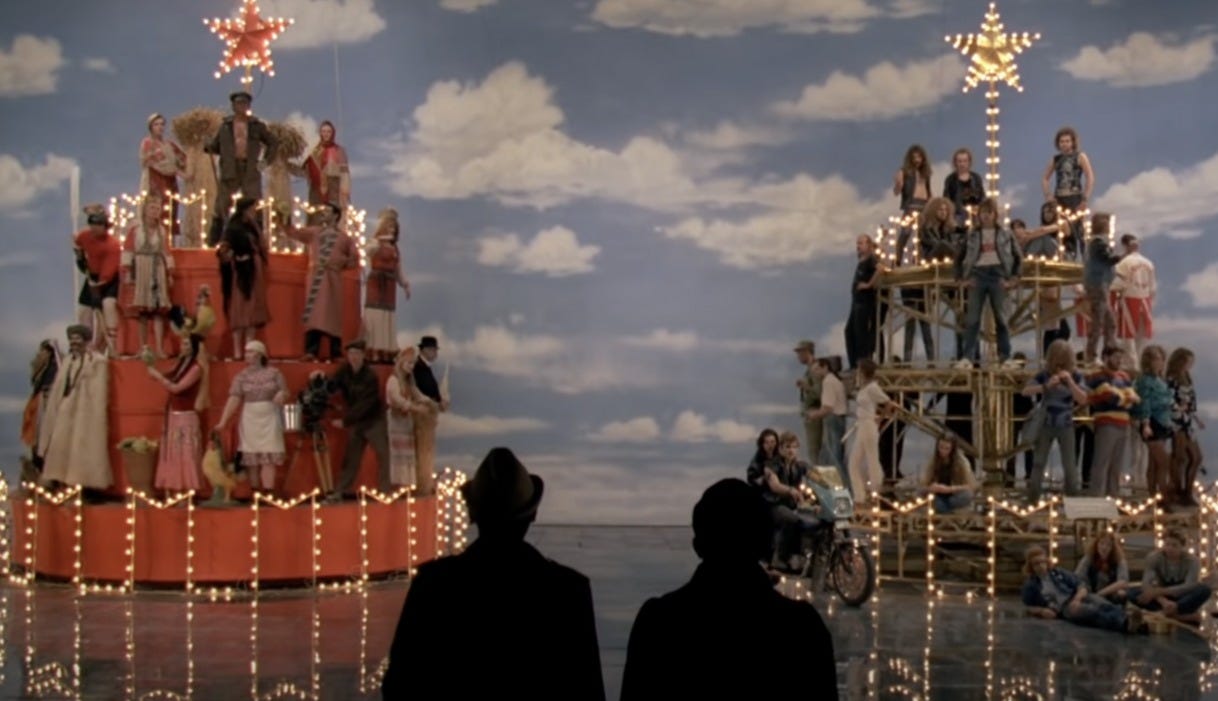
At the same time, my dystopian sci-fi brain kept circling the harsher satire of Polish filmmaker Piotr Szulkin’s Apocalypse Tetralogy — specifically The War of the Worlds: Next Century (1981) or Ga-ga: Glory to the Heroes (1986). I knew that Kin-dza-dza! wouldn’t reach the grotesque or aggressively oppressive levels of Szulkin’s dystopia, but it does work with some of the same ingredients: repetition and ridiculousness while exposing the horror of the system itself. Think: deadpan absurdism versus nightmare satire, or, in layman’s terms, approaching similar ideas from totally different emotional registers.
Kin-dza-dza! ultimately reveals itself to be far stranger — and much drier — than any of those comparisons could quite prepare you for.
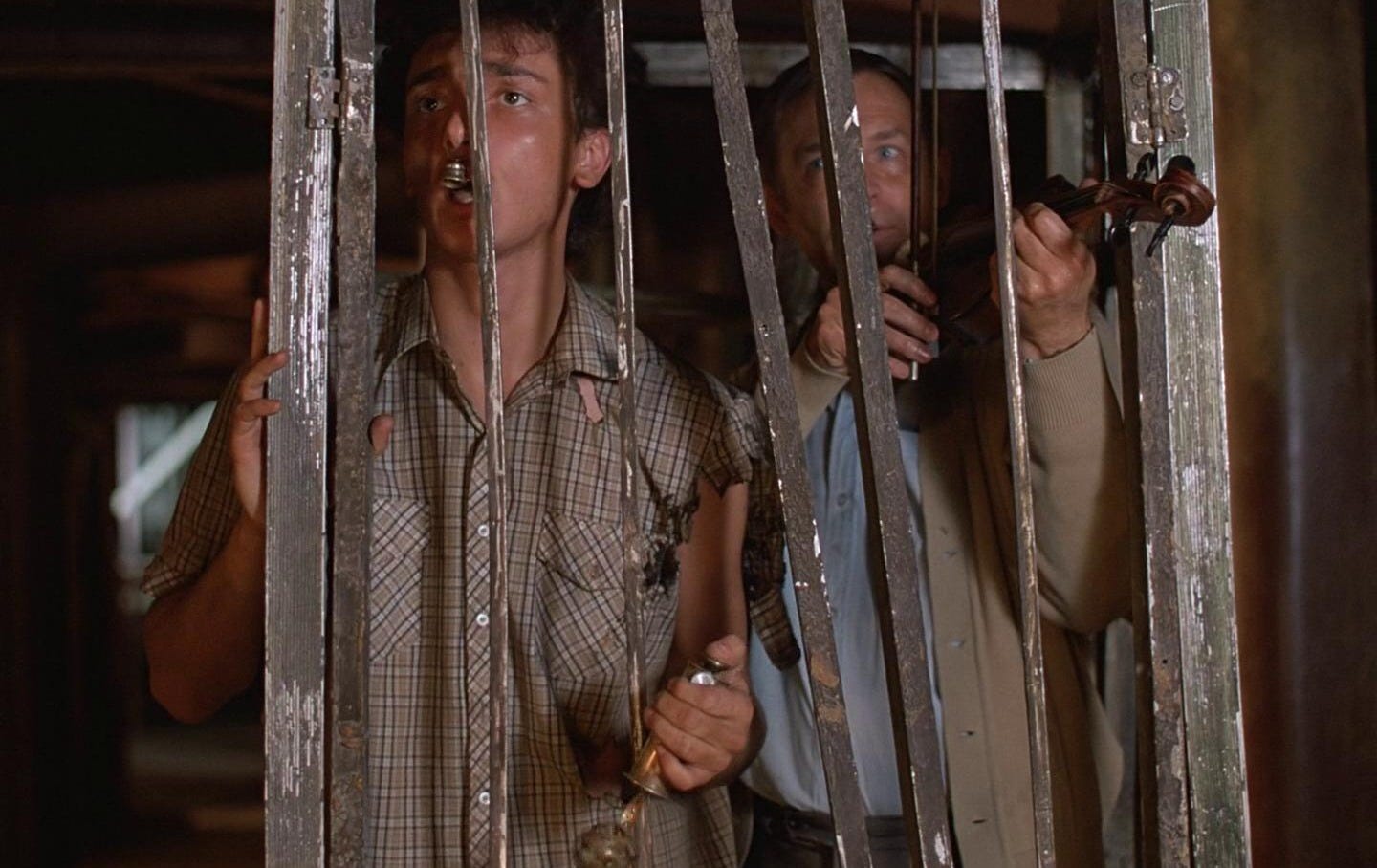
Life on Pluke operates on head-scratching logic… until you surrender to it. The inhabitants communicate using an incredibly reduced vocabulary: “koo” and “ku.” The latter functions as a generalized obscenity, while the former stands in for nearly everything else. Currency comes in the form of “ketse,” which are matches (yes, really).
Meanwhile, social class is determined by handheld devices that flash either orange or green, marking the difference between the ruling “Chatlans” and the subordinate “Patsaks.” Since these beings operate on constant bartering and corruption, you might wonder whether using such devices at close range is wise. Have no fear — status is encoded even further by the color of one’s pants! Crimson trousers mean you’re very wealthy in ketse, and those who come across you must respectfully utter two “koos” in greeting. Yellow means that you’re well-off enough to receive a singular “koo.” If you have neither crimson nor yellow pants, well, I’m afraid you’re a Patsak… and Patsaks must wear a tiny cowbell on their nose whenever a Chatlan is present. With these greetings, what we’re witnessing is a linguistic parody — communication reduced to ritual rather than nuance, as if bureaucratic systems have forgotten what words are even for.
In a 2010s interview, Daneliya summarized how he and co-writer Revaz Gabriadze (whose son plays Gedevan) arrived at this semantic logic for Pluke’s inhabitants. “They annulled all superfluous words, leaving just one: ‘koo,’ for the sake of convenience. So that not to differentiate them by nationality […] they invented a device — the visator.” The reason for both, of course, is exactly what Daneliya explained: convenience. While these rules seem utterly ridiculous, they are obeyed with absolute seriousness. The result? A society that keeps functioning out of habit, long after its logic has collapsed.
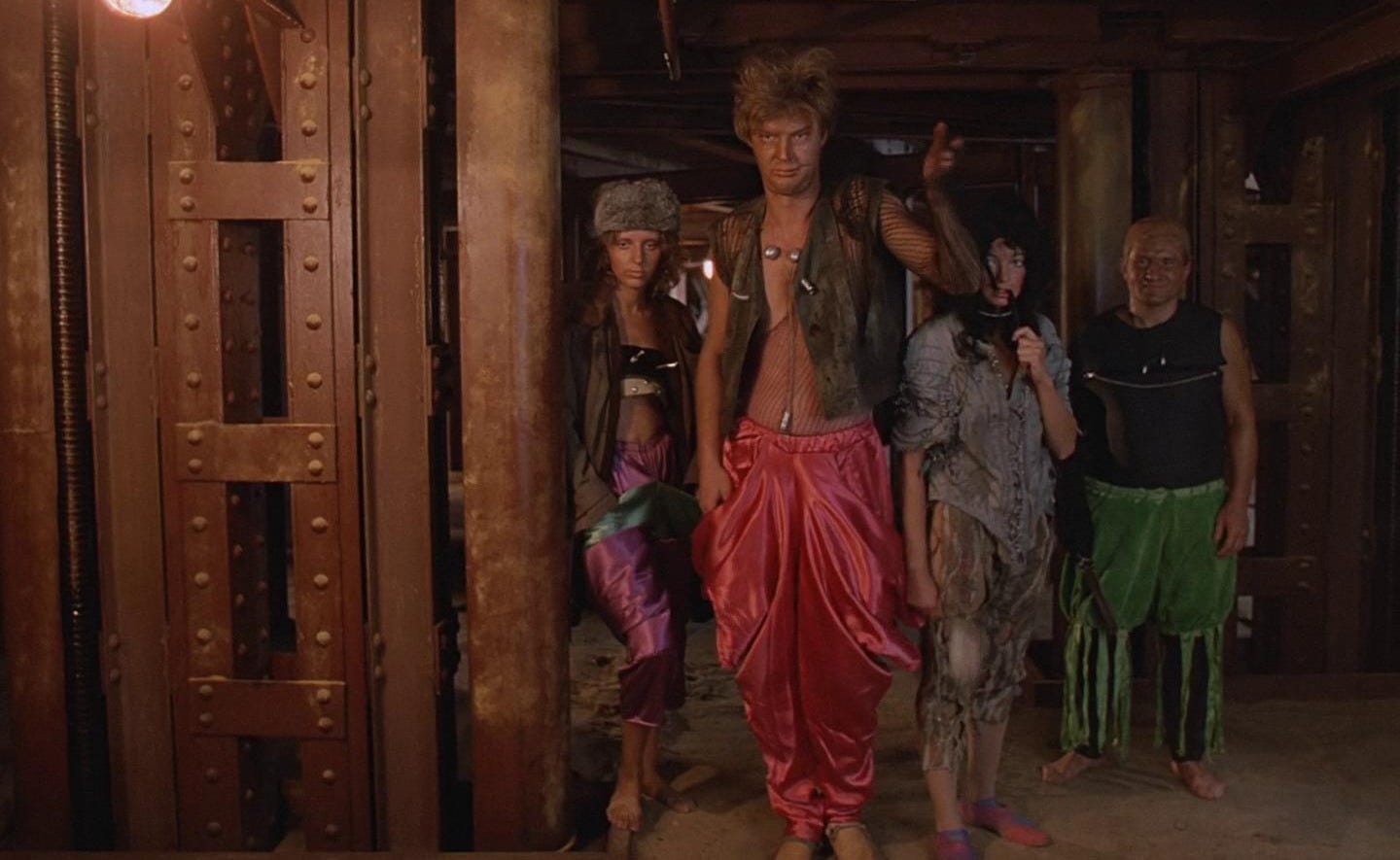
Much of the film’s humor comes from how quickly its protagonists begin adapting to these rituals. At first, they shake them off, with Vladimir wryly telling Gedevan that they’ve landed in a “capitalist country.” Later, once they’re called Patsaks enough times, they declare it “flagrant racism.” Fascinatingly, while these seemingly barbaric beings speak in so few words, they also possess the ability to understand any language almost instantly, immediately recognizing both Vladimir’s Russian and Gedevan’s Georgian. Bewildered by these rituals, our heroes realize they’ll need to play along, and the next thing we know, they’re greeting passersby with the correct number of “koos” and bartering for survival (see: performing songs) like seasoned pros (Gedevan’s delivery of “Strangers in the Night” had me howling, wishing I could throw an entire box of matches ketse at the screen). It’s an unsettling realization of how easily human beings can normalize the strangest systems if they’re desperate enough — or if they remain inside them long enough.
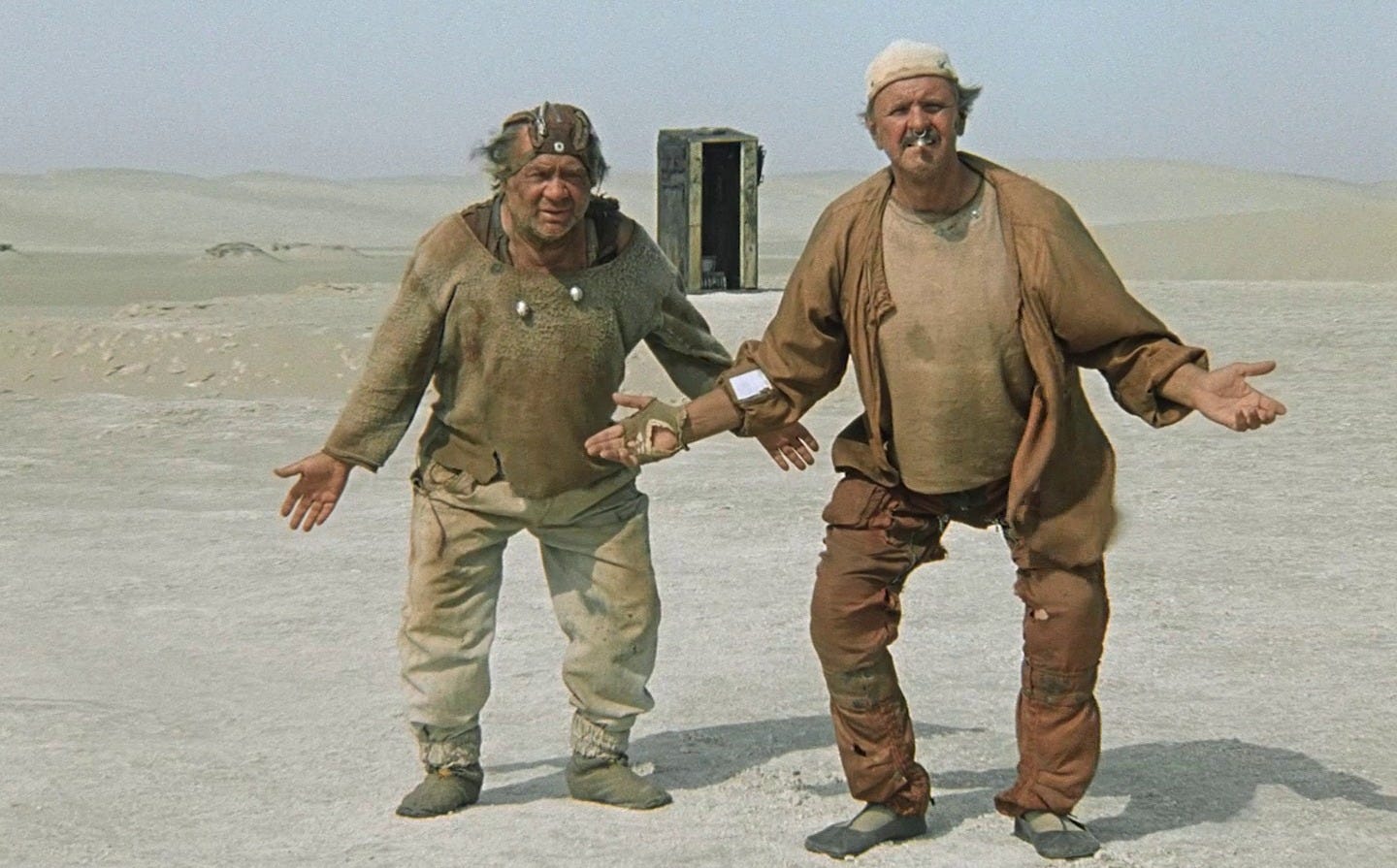
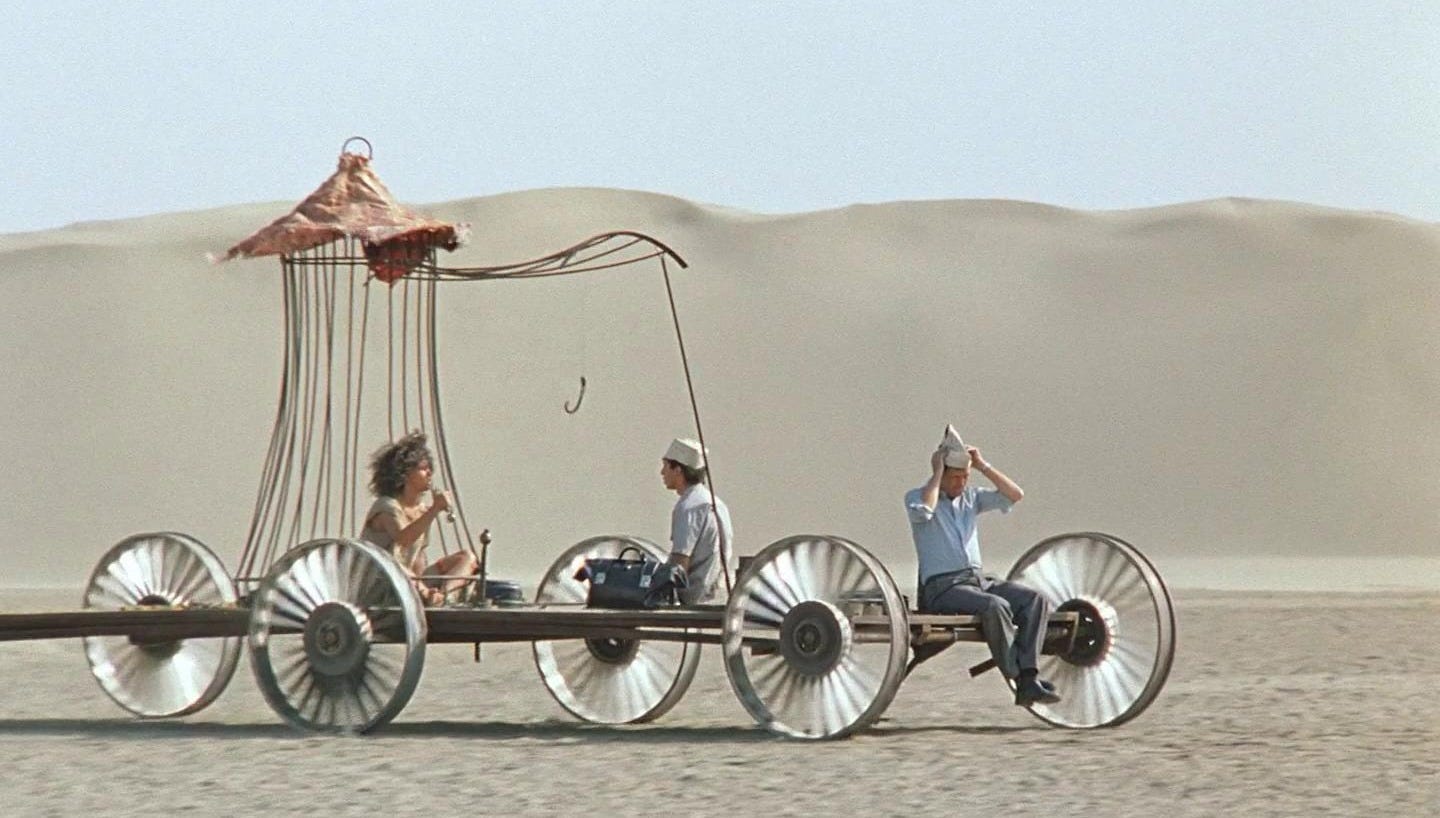
What gives Kin-dza-dza! its odd aftertaste is the pockets of melancholy to be found when the “koos” and laughter subside. At one point, Vladimir and Gedevan sit in the desert wearing paper hats, staring out across a vast landscape with no clear direction left to follow. It’s a fleeting moment, but one filled with existential resignation. By the 1980s, Soviet filmmakers mixed satire and exhaustion with ease, depicting stalled societies where, even when the film was comedic, the background hummed with sadness. As our heroes gaze at this worn-down terrain, they eventually stop resisting.
Shortly after this moment, Daneliya briefly pauses the film to provide a playful “dictionary” of Plukanian terms. Make no mistake, this is an important turning point. By now, Vladimir and Gedevan have moved from confusion to (reluctant) participation, and the audience has no choice but to follow along. Once the rules of Pluke click into place, the film becomes more engaging, allowing us to finally surrender to its peculiar logic.
The longer one spends on Pluke, the more it starts to resemble a cracked mirror of our own world. “About the fact that humankind would finally arrive at what we saw on that planet […] I’m afraid we’ll even outdo them, because we’re already doing that,” Daneliya reflected in that interview, now a decade and a half ago, which manages to feel even more prophetic — and is the film’s bleakest joke.
By the time Kin-dza-dza! ends, Daneliya lands one final joke I dare not spoil. It’s subtle, unsettling, and the perfect answer to the question that opened this piece: how long does it take before the absurd becomes routine?