


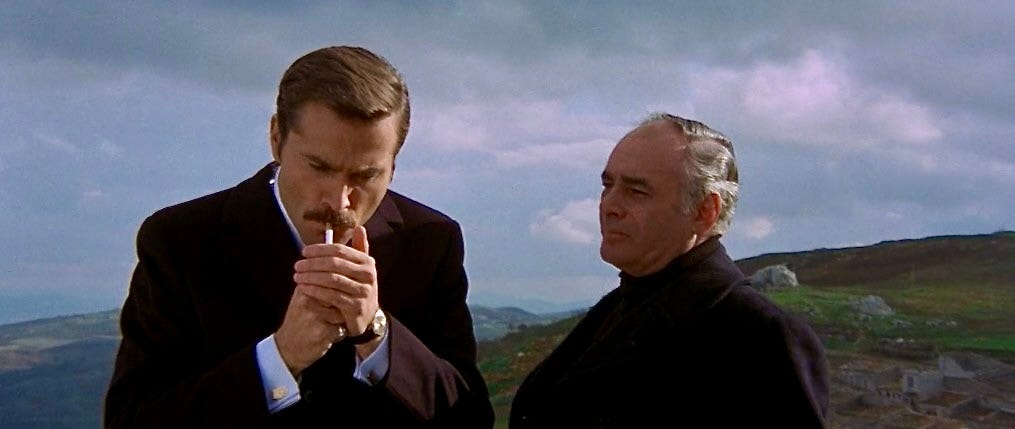
Damiano Damiani’s Confessions of a Police Captain opens in a fog of suspicion. When Deputy DA Traini (Franco Nero) first arrives at a violent Palermo crime scene, he asks Commissioner Bonavia (Martin Balsam) why the powerful construction magnate Ferdinando Lomunno (Luciano Catenacci) has managed to evade arrest despite three attempts to put him behind bars. Could it be a lack of evidence? Bonavia’s answer is calm, yet markedly bleak: “Lack of everything.” It’s a short exchange, but one that points toward the much larger problem at the heart of this 1971 political thriller. Bonavia and Traini both believe in justice, yet what separates them is their faith in the institutions responsible for delivering it. How much faith can justice place in the law?
It’s important not to reduce Bonavia and Traini to “good versus bad.” These two men represent two definitions of justice. Bonavia, the older of the two, has spent years watching procedure fail him. He’s exhausted, his faith utterly destroyed. Traini, on the other hand, remains fresh, believing that the law can work if pursued honestly. Principled to an absolute fault, he declares early on, “I like to be thorough.”
Justice and vengeance do not belong in the same conversation in Traini’s mind, but his idealism should not be mistaken for naivety. “Like an initiatory relationship, between teacher and student,” explained Damiani in a 1972 interview with Les Lettres françaises when describing the two men. “The captain’s starting point is the DA’s destination. At the beginning, the captain already knows, he has lost his illusions, while the DA still has them, they’re tied to his education.”
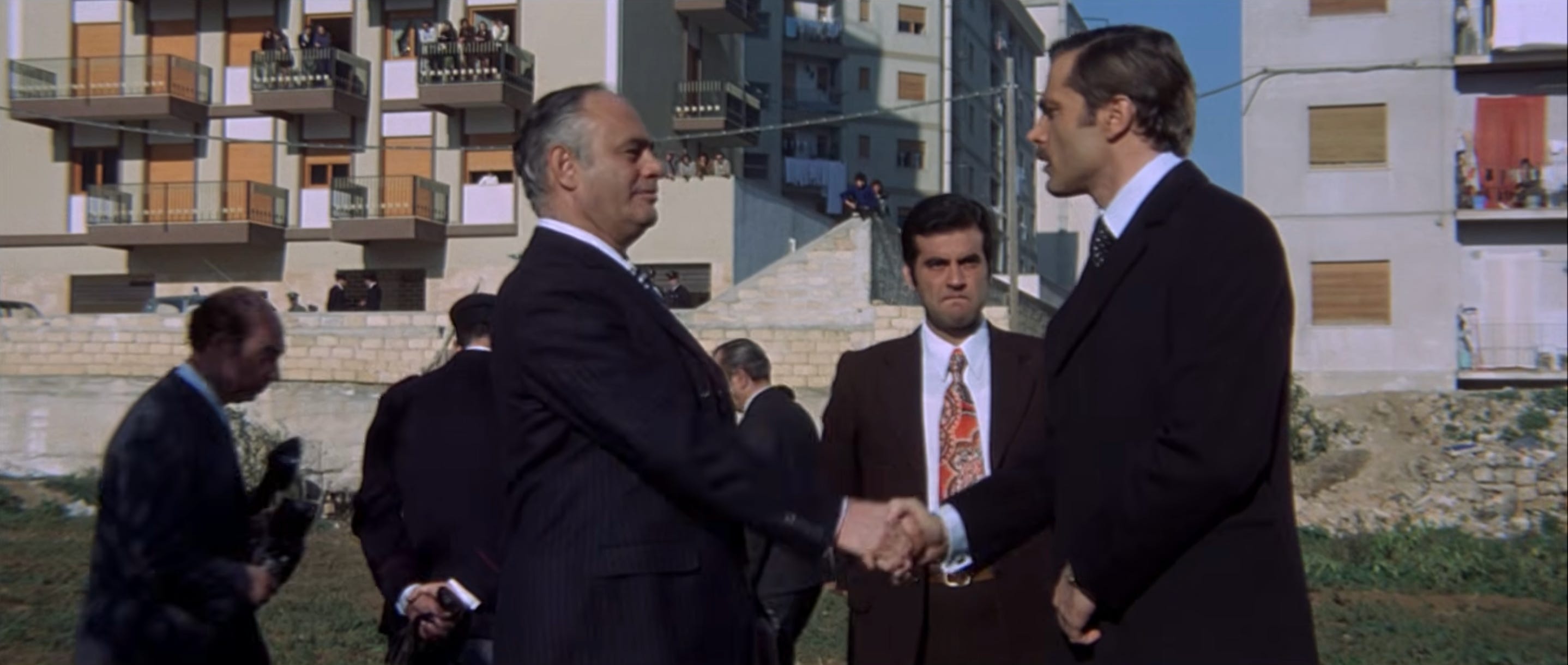
Ultimately, the conflict between Bonavia and Traini becomes truly tragic: they disagree about their methods precisely because they agree about morality.
Balsam brings Bonavia’s worldview to life with an unnerving stillness, as though nothing around him has the power to surprise him anymore. Even as Riz Ortolani’s score swells and swoons at the film’s start, Bonavia barely moves emotionally.
Damiani didn’t conceive Bonavia as a swaggering, guns-blazing archetype, either. According to the filmmaker, the character was partly inspired by real Sicilian police officers he knew who repeatedly arrested Mafia figures to no avail. Other elements of the story, including the labor unrest and Palermo’s real-estate corruption, were also drawn from reality.
At one point, Traini’s superior, District Attorney Malta (Claudio Gora), tells him that Bonavia is “introverted, boorish, but efficient,” dubbing him a “good man.” The irony is that being a “good man” has not protected Bonavia from compromise; he’s operating inside a system that has steadily taught him how little goodness can accomplish on its own.
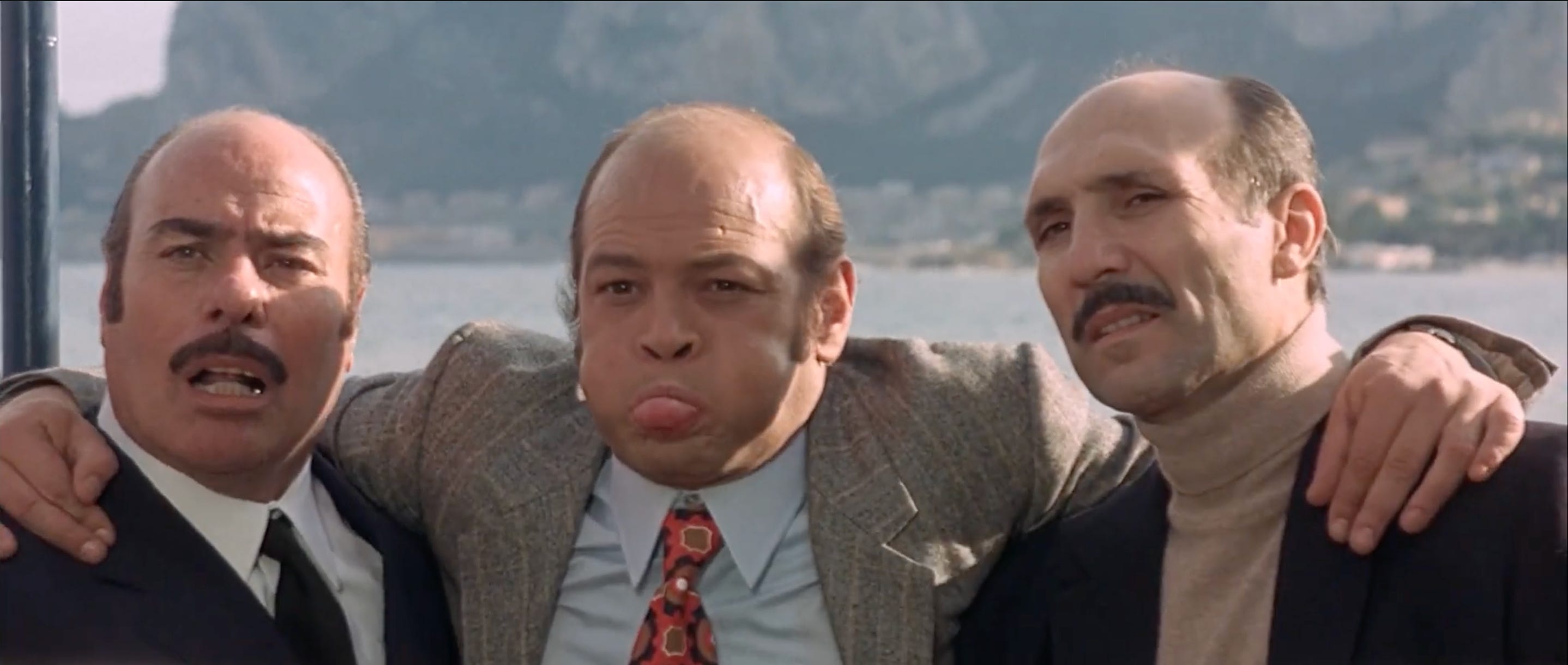
Lomunno is the obvious criminal figure in Confessions, but Damiani’s target is much larger. Confessions of an Entire Goddamn System, more like. “We need honest social structures,” he declared in his 1972 interview. “We believe [the judiciary] is eternal, untouchable, neutral — yet this neutrality is relative.” The film becomes much more disturbing once it’s made clear that Lomunno is connected to almost everything: banks, politicians, construction, property, judicial authority, you name it. One wonderfully poisonous line comes as Traini begins connecting the dots of his investigation. As he explains them to Malta, his boss warns him to pursue justice, of course, “but with caution.” How deliciously sinister that even the vocabulary of righteousness comes with bureaucratic qualifiers. It’s terrifying.
Perhaps my favorite part of Confessions is that Damiani’s film never feels like a bland political lecture. It’s genuinely thrilling. Damiani understood genre as a vehicle for political ideas, tracing part of Italian political cinema’s lineage back to the American film noir he encountered in his youth, as he shared with French film magazine Écran in 1972. Damiani admired Francesco Rosi’s political analysis, as well, but felt that the filmmaker observed his subjects from a distance. Notably, however, he believed Rosi’s cinema led to Elio Petri’s work, particularly Investigation of a Citizen Above Suspicion (a personal favorite of mine, as well, and one I urge you to seek out). “Petri’s film is what then allowed me to make Confessions of a Police Captain — which will in turn allow another Italian filmmaker to go even further in that direction,” he told Écran.

Roberto Curti, an authoritative scholar on Italian crime cinema and the poliziottesco, likewise notes just how perilous Damiani felt it was to address this institutional rot, with the filmmaker again crediting Investigation as an important precedent. Curti takes this lineage one step further, positioning Confessions alongside Investigation among the major films preceding the 1970s poliziottesco explosion. In Italian Crime Filmography, he goes so far as to call it “the true antecedent of the poliziottesco,” which many critics trace to the surprise success of Stefano Vanzina’s Execution Squad in 1972.
Et voilà.
With Confessions, Damiani communicates the politics through crime-film mechanics. Distrust abounds: people follow one another, surveillance is endless, and even those supposedly on the same side tap each other’s phones. Corruption keeps spreading outward until it feels like no one possesses the complete picture. Damiani described political cinema as creating “shocks” in public opinion through emotion, and Confessions embodies that philosophy, making you anxious long before you start analyzing why.
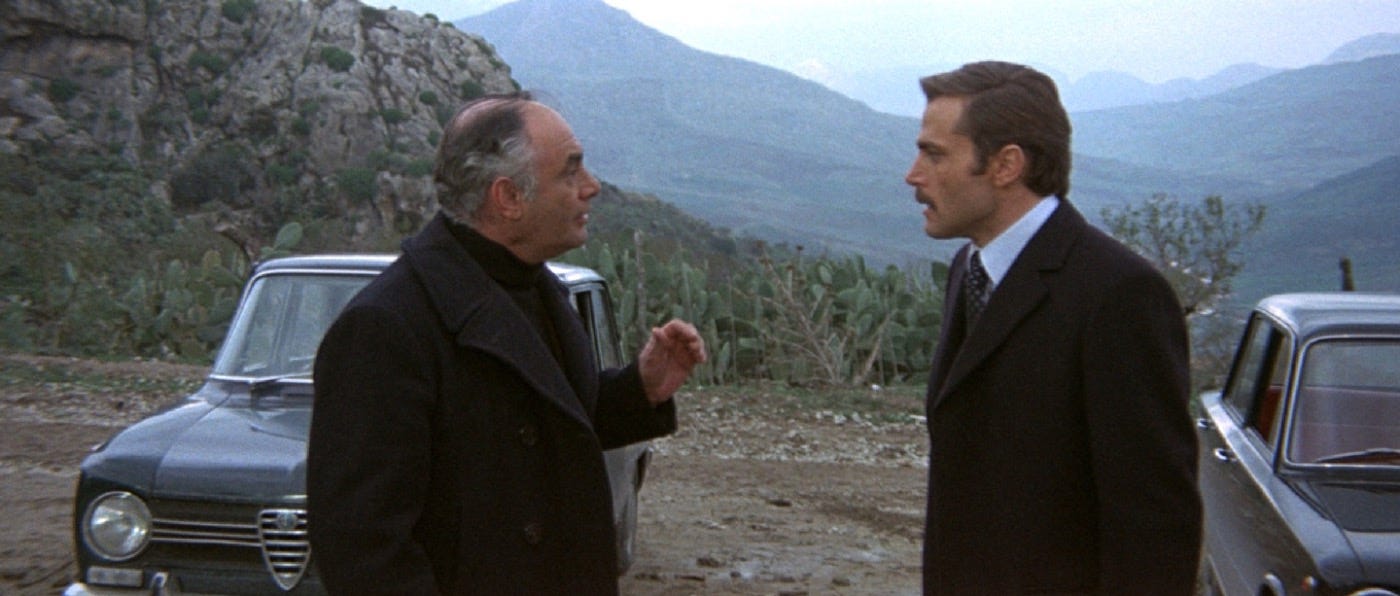
Ironically, for all their friction, Bonavia and Traini are never as far apart as either man believes. Their antagonism boils over into a full-blown screaming match, during which Damiani finds a visually comic way to emphasize their similarity. After shouting themselves hoarse, both men storm back to their vehicles, still bristling with frustration. The catch? Each man has climbed into the other’s car. Once they realize the mistake and switch back, Damiani sends them down the road on the same path anyway. While both spend the scene hurling insults and demanding to know what side the other is on, Bonavia lands an extraordinary question aimed at Traini: “What’s your limit?” Is this perhaps the film’s essential question? By now, what’s legal isn’t even the main part of this argument, but at what point does participating faithfully in a broken system become mere participation in the injustice that system produces? Conversely, what happens to justice itself when an individual decides that the system doesn’t deserve their obedience? Traini and Bonavia are both intelligent and stubborn, but they’re also trapped.
Bonavia and Traini are both committed to justice, no doubt about it. Confessions of a Police Captain is bleak because Damiani understands how little individual goodness can accomplish on its own. That’s what’s unsettling. Political authority, money, law, and criminal power can all become so entangled that determining where one ends and another begins is almost impossible.
I keep returning to Bonavia’s question, which hangs over everything, challenging not only Traini but the audience, too: What’s your limit?