


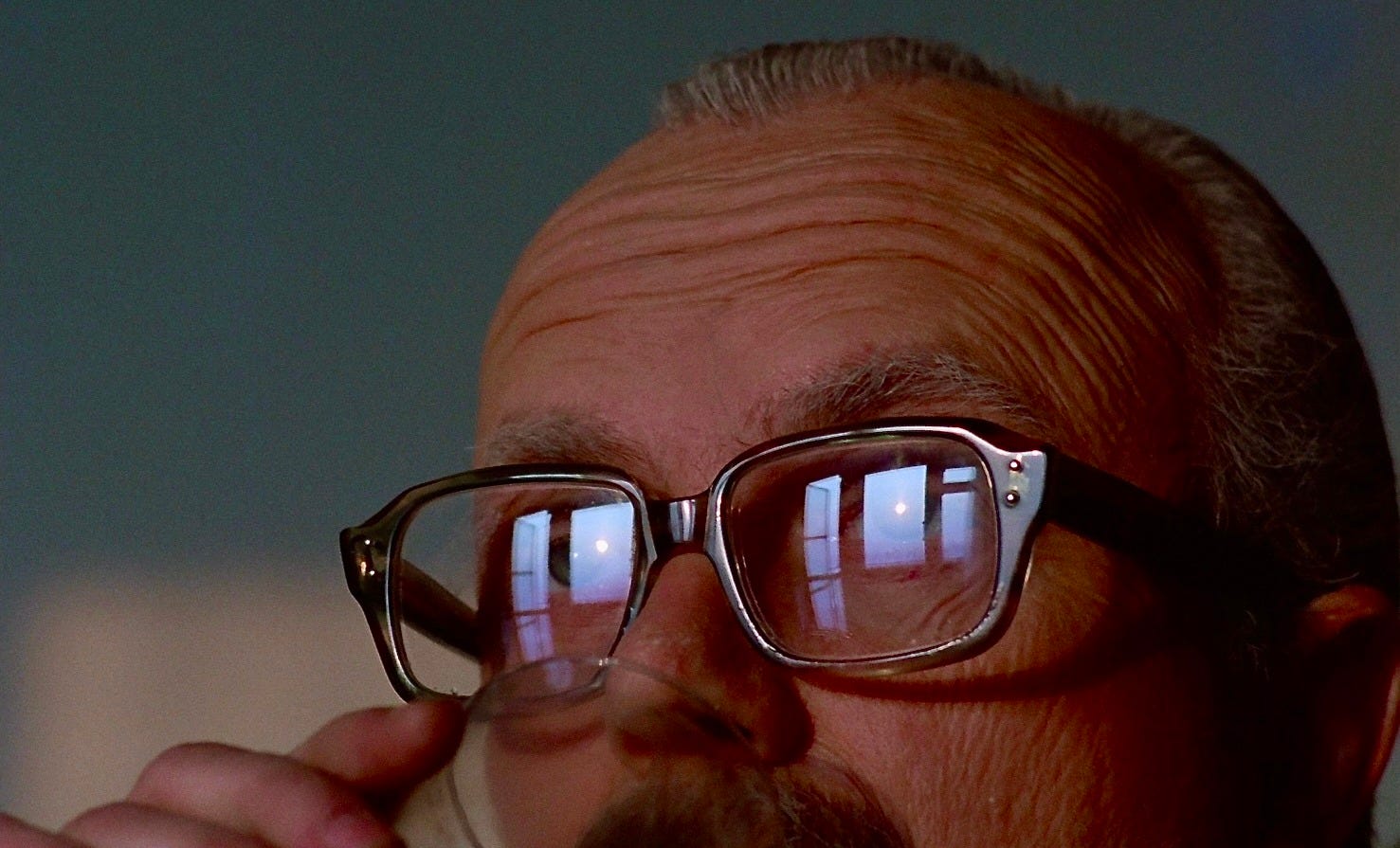
Grzegorz Królikiewicz’s The Dancing Hawk (1977) is yet another descent into the Polish filmmaker’s feverish, visceral style of cinema. Where his feature film debut, 1973’s Through and Through, was nightmarish and suffocating, The Dancing Hawk feels even more furiously corrosive. This time around, the effect is one of prolonged agitation, mirroring the story that unfolds on screen: a portrait of a man, from birth to death, slowly severing himself from his own humanity.
Adapted from Julian Kawalec’s novel and set against the shifting social realities of postwar communist Poland, The Dancing Hawk introduces us to Michał Toporny (Franciszek Trzeciak), a peasant man who, thanks to his work ethic and slippery, opportunistic nature, rises through the ranks to become an industrial magnate, but in the process transforms into a hollowed-out version of who he once was.
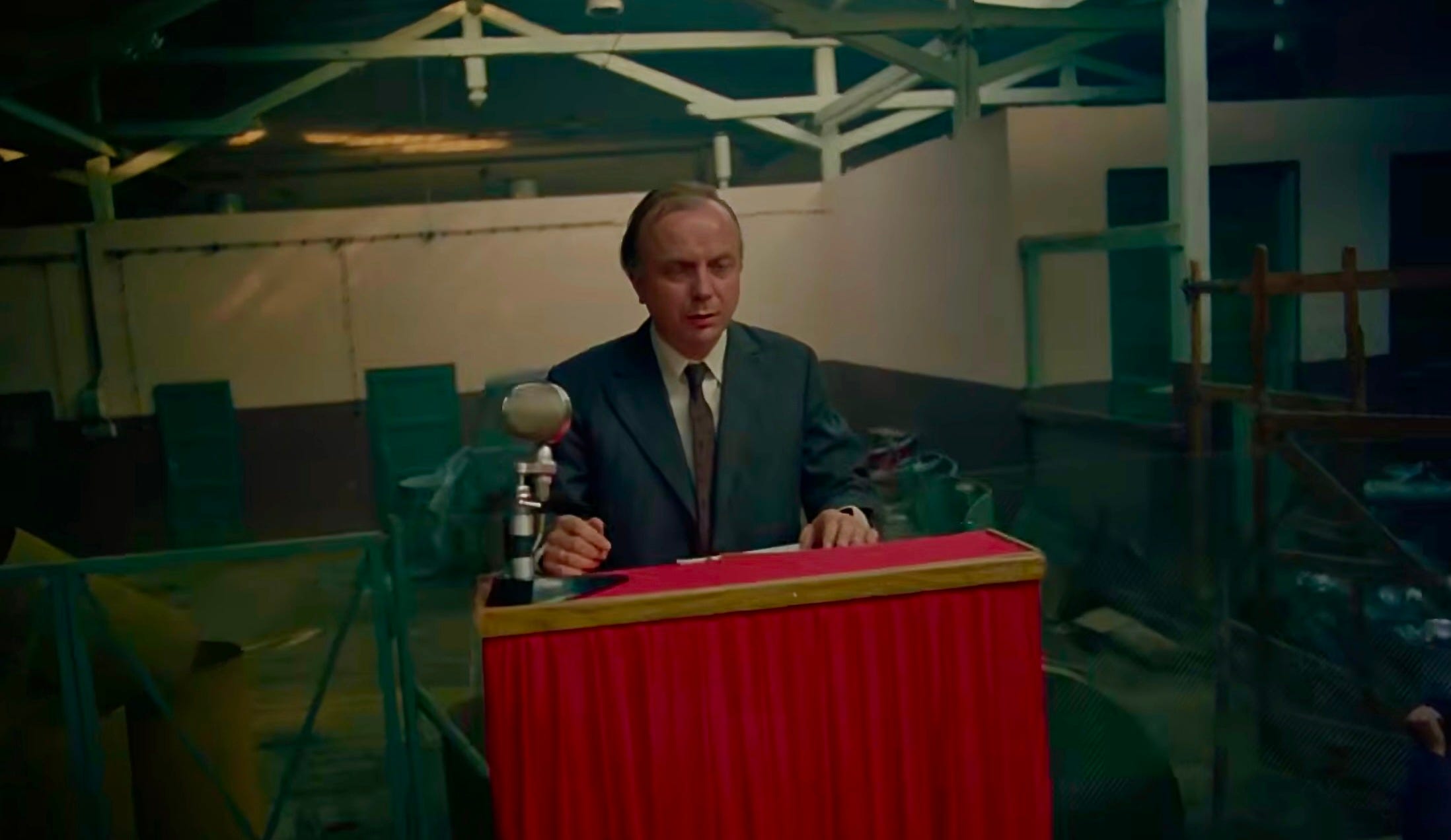
It would have been easy for Królikiewicz to chart Toporny’s ascent clearly, but he was never interested in neatly filling in the gaps for his audience. Królikiewicz was a filmmaker who thrived on ambiguity, often pushing viewers into a sensory experience that mirrored the psychological states of his suffering characters. Here, Toporny’s world is fractured through disorienting edits, asynchronous sound, surreal imagery, and incredibly claustrophobic — and sometimes nauseating — camerawork (thanks in large part to cinematographer Zbigniew Rybczyński, whose work six years later on Gerald Kargl’s Angst would carry the same anxiety-inducing intensity). In The Dancing Hawk, all of these elements come together to transform social mobility into a process of spiritual erosion.
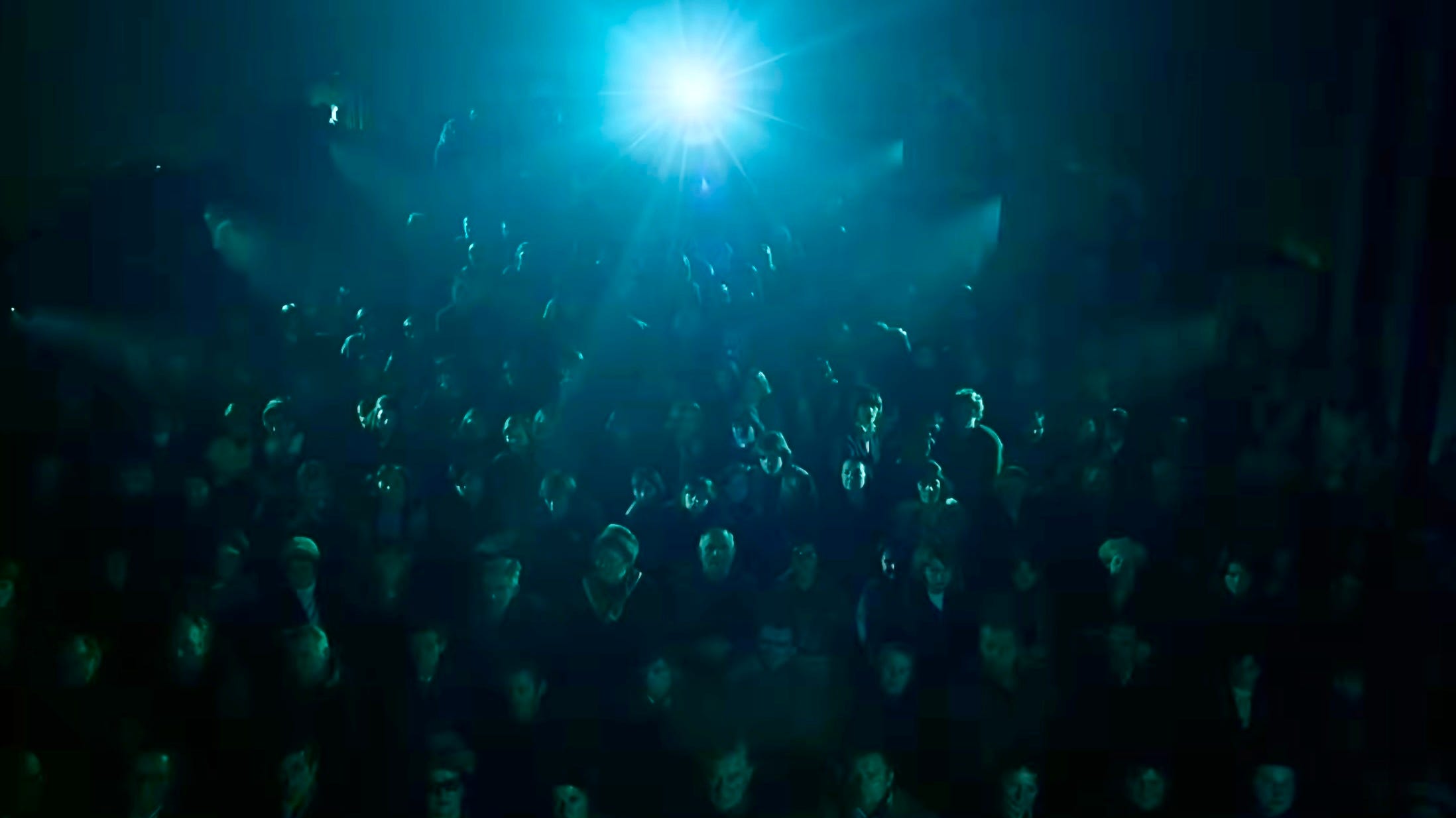
The system that Toporny wishes to thrive in rewards self-erasure — and it’s exactly what he commits himself to. Living in a small farming village with his wife and newborn, when Toporny gets his first whiff of a way out, he cruelly declares to his wife, “Honey, I’ve had enough of this life!” Calling their home a “hovel,” he glares at her, disgusted, and leaves. His wife continues to wail long after he’s gone, and even as the seasons change, she keeps mourning. In that time, Toporny trades it all. An upper-class wife, another newborn son, and a chance to become someone else, something more than he once was. Initially, he’s embraced. A narrated reel plays to an audience, celebrating Toporny’s success: “We are building a new order, with new people. People like him can achieve anything as obstacles are no longer there!”
This, of course, is a lie. Whenever Toporny jumps over an obstacle, a new one materializes, seemingly more difficult than the last. Eventually, he has to make a decision that symbolizes the entire rejection of his former life. When he decides to go through with it, he crosses paths with an old mentor. Toporny tries to argue, pleading, “You taught me to work for the country, not just my own folks.” The man’s response is the whole film in miniature: “I taught you to have a heart.”
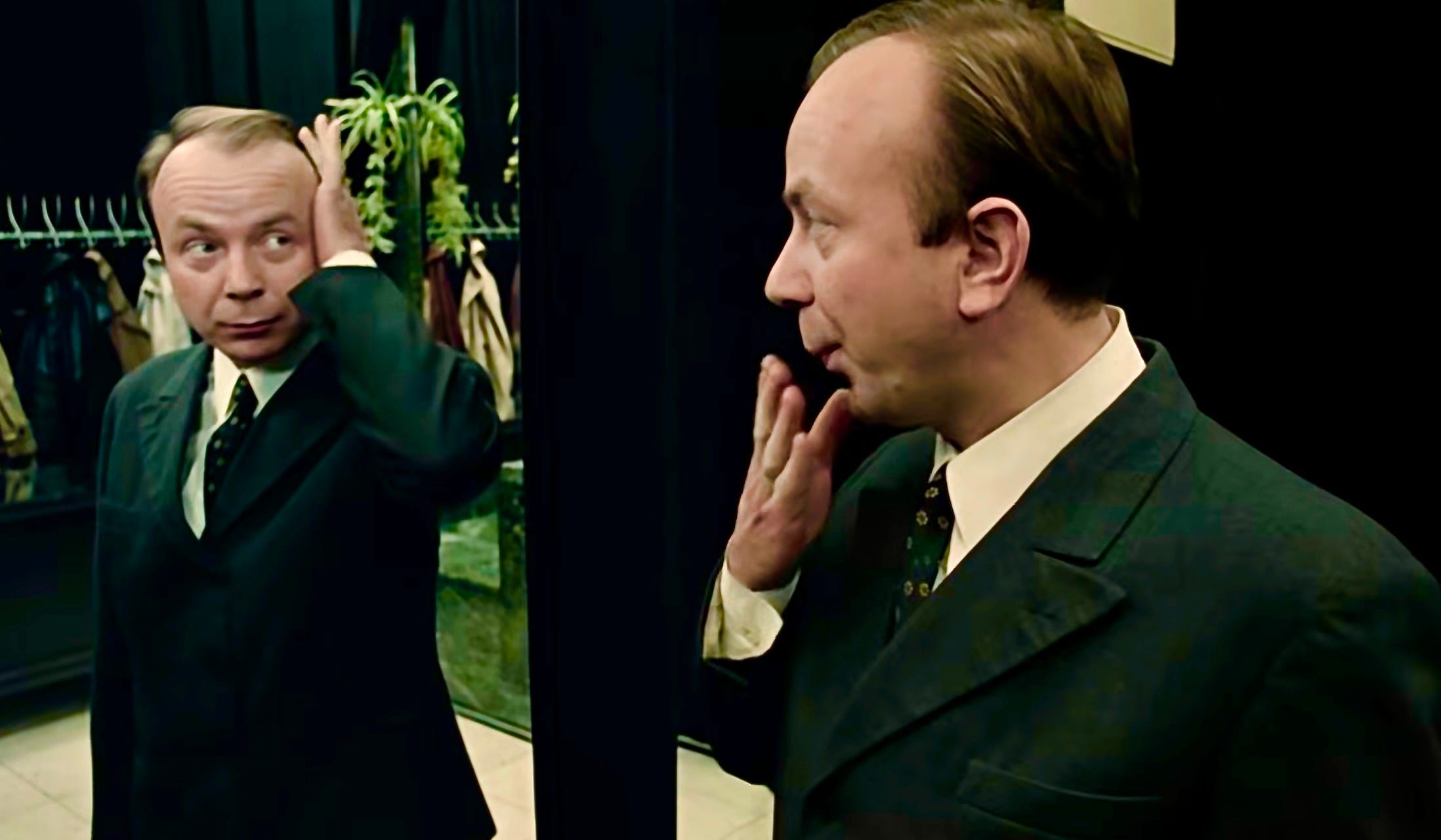
But by this point, Toporny has already fractured in two. The clearest articulation of this comes a few scenes before this one, when Toporny is staring into a mirror as he dresses for his new life among Poland’s managerial elite. What we’re staring at is much more destabilizing: his reflection doesn’t mirror his movements. Instead, it combs its hair differently and touches its own face independently. Who is this outsider? Which one is Toporny?
The influence of Orson Welles’ Citizen Kane hangs heavily over The Dancing Hawk. Both films trace the gradual unraveling of men who attempt to reinvent themselves through systems of power and status (the Radiance release includes an essay by film scholar Piotr Kletowski, who cleverly dubs Królikiewicz’s film as a “plebeian and multidimensional Citizen Kane”). However, while Welles’ Charles Foster Kane becomes increasingly isolated through his newspaper empire and sprawling estate, Toporny’s transformation is far less somber and much more abrasive. This isn’t a story of grandeur — and Królikiewicz makes that clear.
As Toporny continues his upward climb, Królikiewicz progressively destabilizes the world around him. We listen to conversations – and entire scenes – that loop unnaturally, sound that’s disconnected from the images on screen, and even rooms themselves that rearrange as our lead stands within them. By choosing to externalize Toporny’s mental decline, we’re forced to inhabit it alongside him.
Yet, for all its caustic rage, The Dancing Hawk never fully spills over into treating Toporny like a monster. We watch as he grows more corrupt within this social machinery, further estranging himself from his roots, but the real tragedy is that the system he lives in actually rewards that estrangement. “This is a downfall story, essentially,” explains critic Carmen Gray in an interview on the Radiance disc extras. “With the idea that if you’re living in some kind of oppressive or corrupt system, and if you sacrifice your own dignity or respect, not only to go along with the system, but to prosper and do well in it, it can never end well for you, because you’ve sold your soul.”
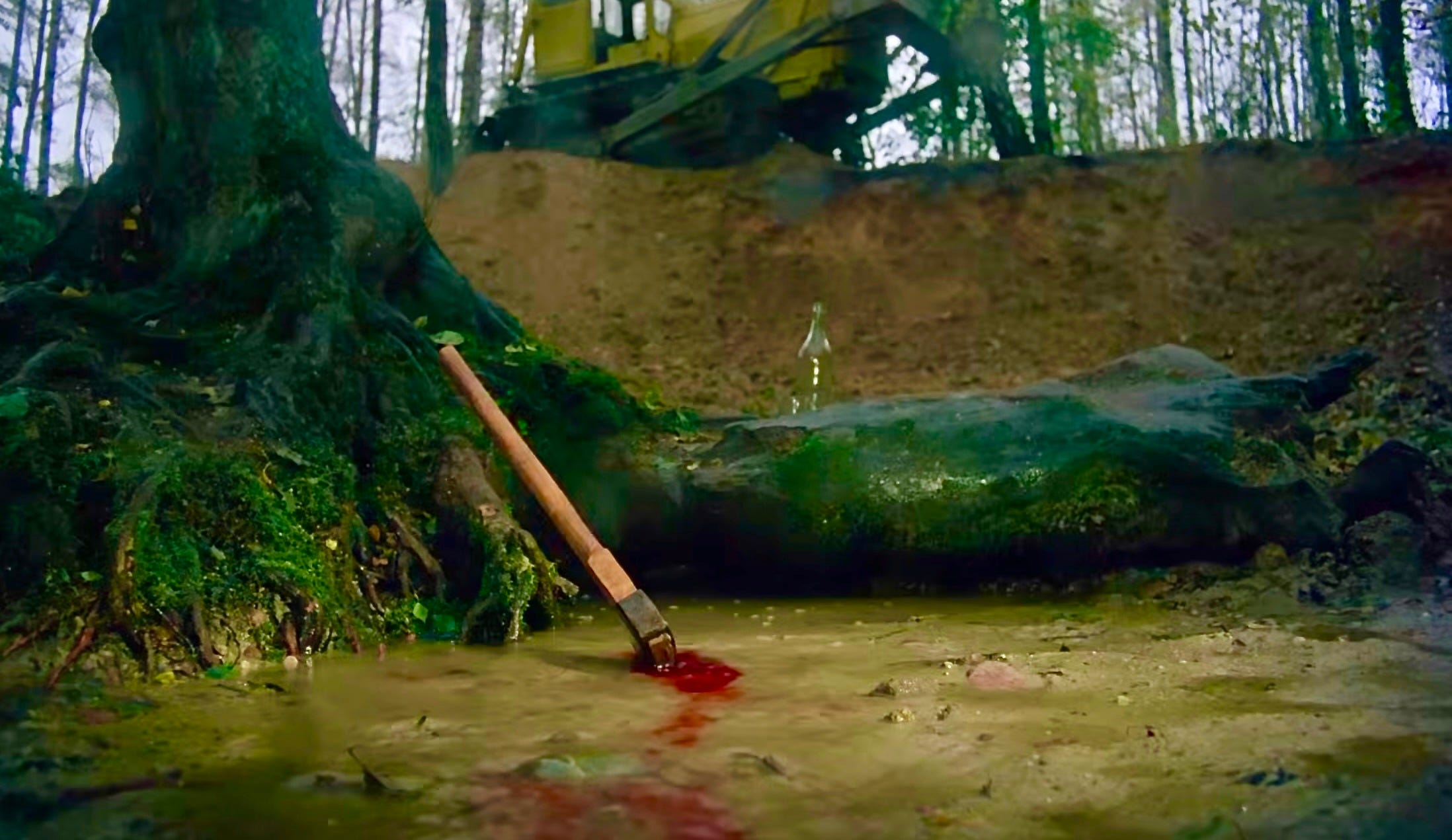
Notably, Królikiewicz also chooses to steer clear of overt on-screen violence, never allowing it to become spectacle in the first place, like in one critical scene in the forest near Toporny’s village. This is an approach similar to what Królikiewicz did in Through and Through, in which the murder committed by our protagonists is kept off-camera. While the violence is withheld, Królikiewicz makes up for it by emotionally overwhelming the viewer with intrusive camera angles and carefully weaponized sound design.
What makes The Dancing Hawk so devastating is that Toporny doesn’t realize how consumed he is with ascending into this new social order until it’s too late. At home, with his new family, he manages to push his wife away so far that, in one moment, when he comes home with the joyous news of yet another promotion, nobody is there. In fact, every attempt at reinvention leaves behind another emotional casualty. Be it his wives, his children, or even an entire village, Toporny scorches it all.
By the time we get to the film’s final act, Toporny has certainly escaped his origins, but even more so, he’s permanently severed from them. While visiting his doctor to discuss his failing health, Toporny comes to a painful realization: he’ll likely die alone. Not for want of trying, though far too late to repair what has been lost, he decides to take his emotionally distant sons back to the village he once abandoned. Once they arrive, someone hurls a rock through the back car window, causing the boys to suddenly flee. This moment is critical, signifying that the violence Toporny helped create finally returns — physically — toward him. It’s never revealed who threw the rock, but the answer feels irrelevant. Królikiewicz doesn’t want to give any grand speech or cathartic showdown, because the question itself is beside the point. It’s about the loss of one’s roots, where the very ground he crawled on as a child is now rejecting him entirely. As Toporny’s personal collapse only continues from here, the film suddenly becomes much more hollow. His children participate in the burning of Toporny’s old farmhouse, suggesting that the only thing their father passed down to them is destruction. What could possibly be the idea of a “home,” when they were never given a real one to begin with?
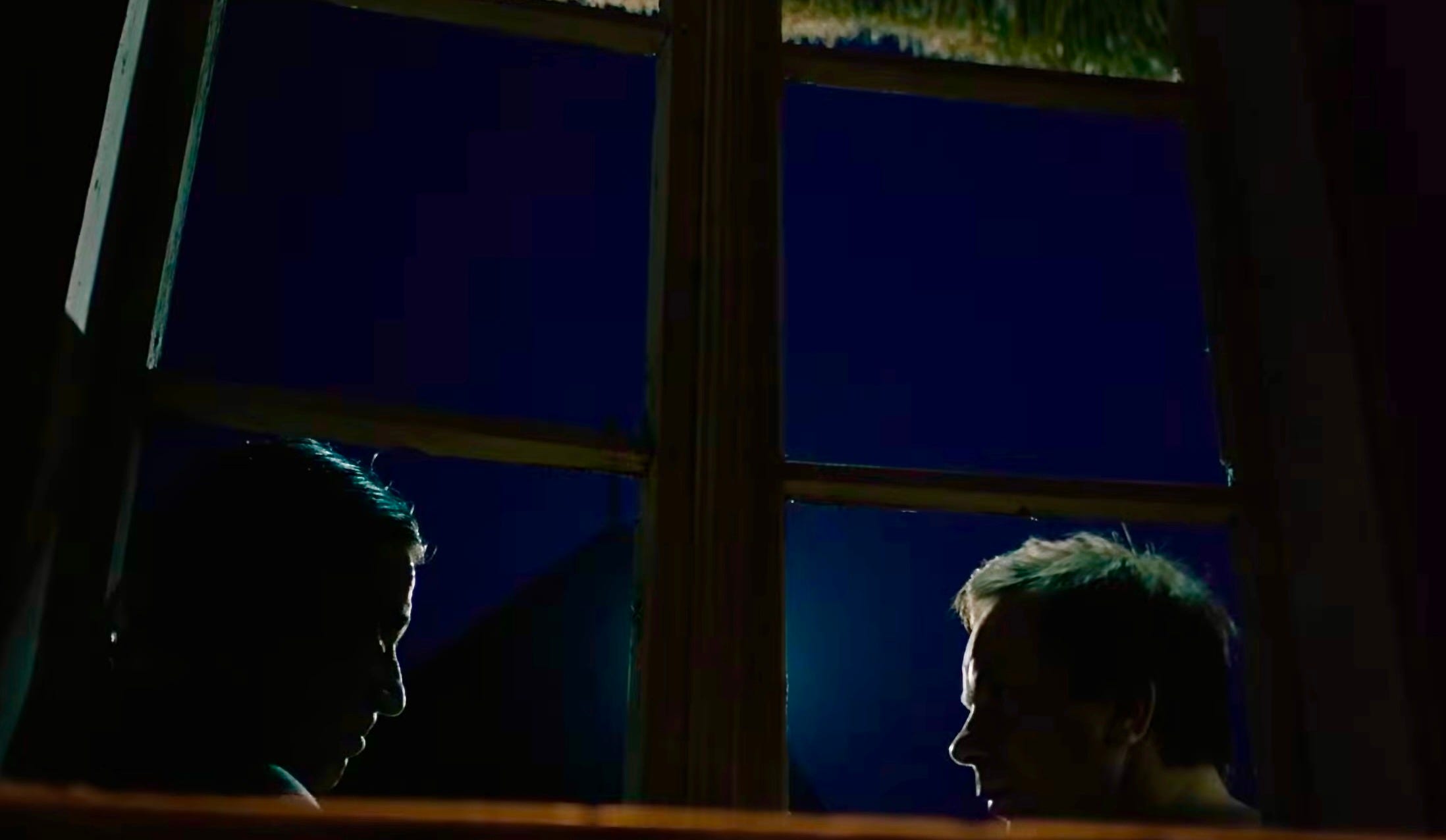
Approaching the conclusion, Królikiewicz bookends The Dancing Hawk with imagery that appeared near the beginning. Another storm sweeps the same farming landscape, but this time, we’re not watching a struggling young farmer attempt to survive it. By now, Toporny’s fate is largely relegated to the margins, but the physical and emotional demolition he’s left behind is fully a part of the ecosystem. Spiritually emptied out while the world deteriorates alongside him, the true horror of The Dancing Hawk is Toporny’s very own success.
Another fascinating essay on a filmmaker I have yet to dive into; mainly because his work remains almost impossible to find outside the physical releases. You're description of this one in particular seems right in the wheelhouse of my taste...that kind of plotless, stream of consciousness style of storytelling. Just might have to buckle down and blind buy some Królikiewicz, then. I trust your cinephile judgement here :)