


Isn’t it delightful when you start a new project with one idea in mind, only to have it morph into something you never would have guessed? Like your brain cells suddenly break into the most elegant waltz (mine are as I type this while listening to Cho Young-Wuk’s Oldboy score), slowly tracing a pattern you didn’t even know was there. I’m grinning from ear to ear writing this round-up today because, after going through my stack of physical media, I noticed two films that clearly belonged together, and a third that just might fit.
Lo and behold, a few things have happened since then. For one, all three titles come from Radiance, whose catalog is, coincidentally, currently 50% off at Barnes & Noble. The sale runs until August 2nd, so I’m hoping to cover a few more titles before it wraps up.
But that wasn’t the real surprise. I started this little project pairing together what I thought were three political films. Somewhere between finishing the third essay and reading them back-to-back, it dawned on me that politics were the scenery all along.
Across Jean-Pierre Mocky’s Solo (1970), Brian De Palma’s Hi, Mom! (1970), and Francesco Rosi’s Illustrious Corpses (1976), each protagonist begins their journey convinced they’re somehow standing outside the forces shaping the world around them. In Solo, Vincent thinks he can skirt around both history and the system. In Hi, Mom!, Jon mistakes observation for distance. And in Illustrious Corpses? Poor Inspector Rogas has no idea just how alienated he is.
The filmmakers follow suit and end up dismantling the genre sandbox they’re supposedly playing in. With De Palma, comedy curdles into something terrifying. Mocky’s film starts off feeling like it’ll be a slick, jewel thief caper, before becoming much more tragic. Rosi’s story (adapted from Leonardo Sciascia’s novel, Equal Danger) begins as a detective tale, only to leave everyone with questions and secrets.
For these reviews, I wanted to track that very dismantling. Let’s rewind and revive.
Hi, Mom! (Brian De Palma; 1970)
Why does this movie keep smiling at the audience while everything it’s showing becomes increasingly grotesque? It helps to think of it as a deranged variety show of the 1970s. The most surprising thing about Brian De Palma’s Hi, Mom! isn’t its politics or its provocations, but how funny it is and how unsettling it feels to be laughing alongside it. Again and again, the film invites giggles through a young Robert De Niro’s shameless charm and relentlessly buoyant energy, only to reveal that the ground beneath those jokes has been slowly shifting the entire time. By the time De Palma arrives at the oft-discussed Be Black, Baby sequence, the laughter turns to uncomfortable horror, before unexpectedly returning in a different form. This time, it’s nervous, because you’re left wondering when exactly the comedy stopped being comfortable, or whether it ever really was.
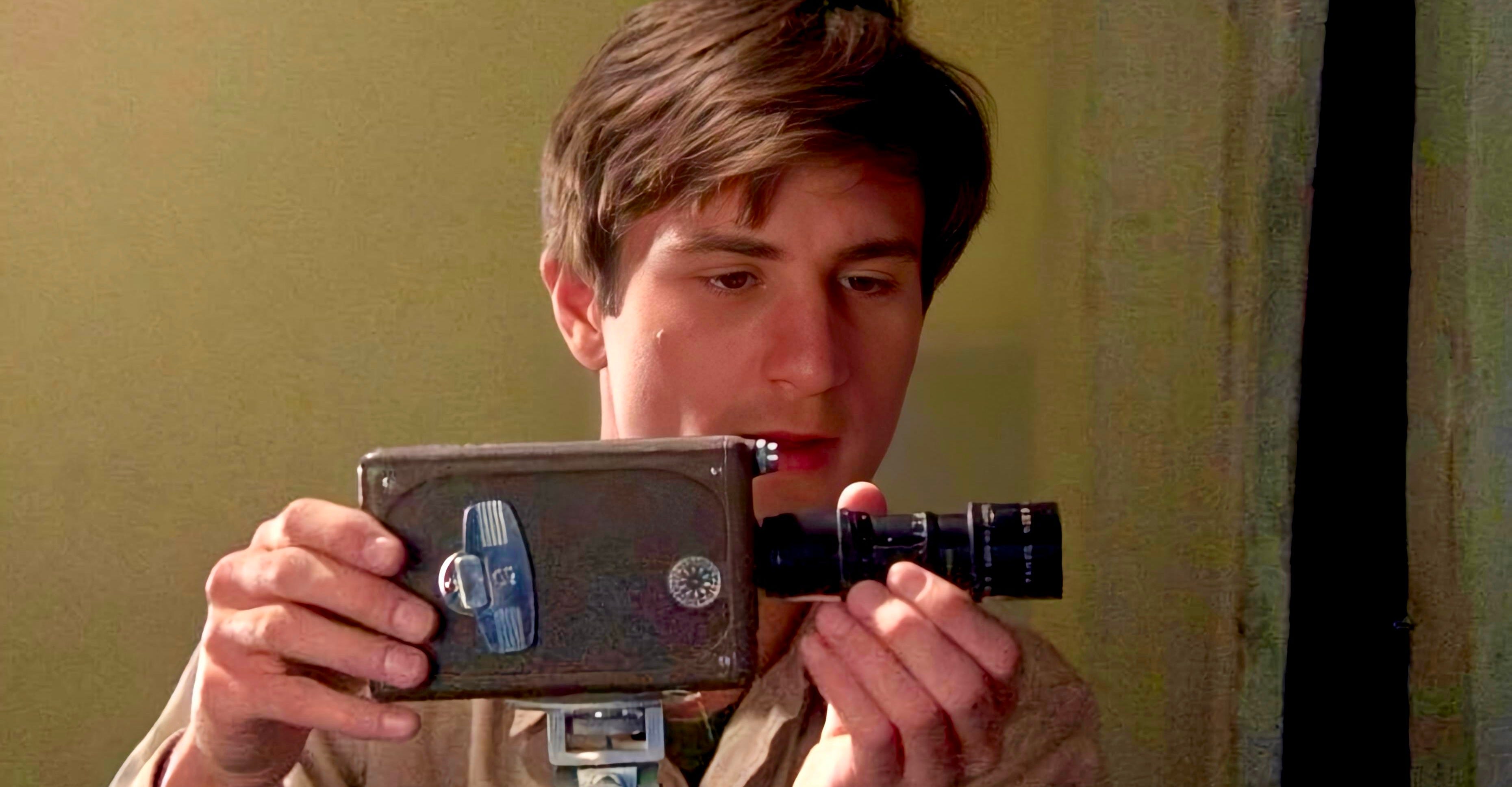
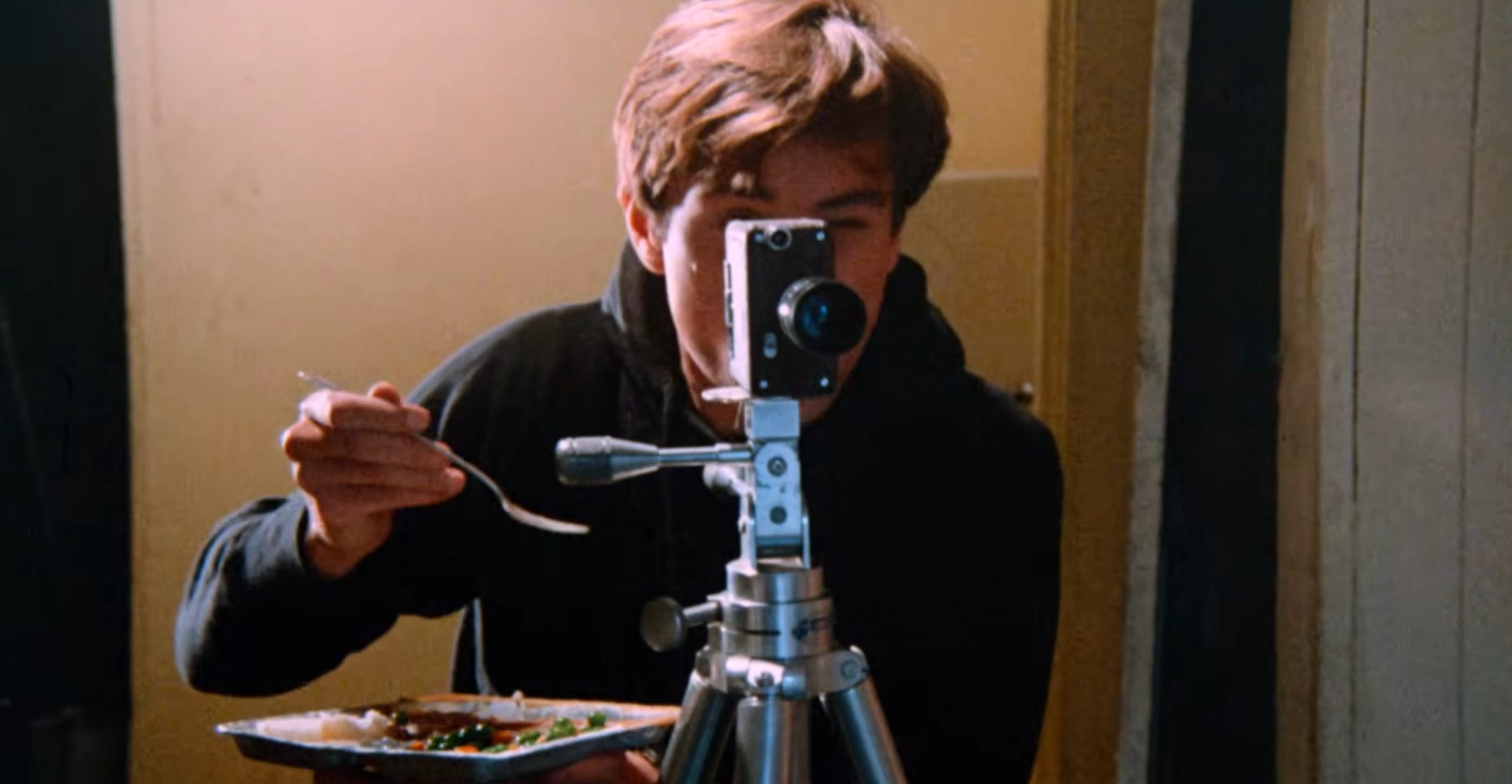
The film follows De Niro’s Jon Rubin, a Vietnam War vet, who returns to New York City and decides he’ll become an amateur pornographer. He rents a comically vile apartment in Greenwich Village (complete with soiled cat litter in the bathtub — great!) because its windows face a more affluent high-rise across the street. As he sets up his camera to Eric Kaz’s jaunty theme song, we discover that his specific brand of adult filmmaking is what he refers to as “peep art,” or, as a bigwig porn producer Joe Banner (Allen Garfield) calls it, “Confessions of a Peeping Jon.” Our lead’s slimy antics shouldn’t have you howling, but the film pushes you to do so anyway, be it through Kaz’s music, the banter between Jon and Banner, or the bizarre way we watch how things unfold in the building across the street for the first time: a mash-up of Alfred Hitchcock’s Rear Window meets… the Brady Bunch title sequence. De Palma’s obsession with multi-frame split screens is on full display here, and by dividing the screen into a grid of windows, the layout mimics the iconic — and wholesome — sitcom grid. The satirical juxtaposition is brilliant.
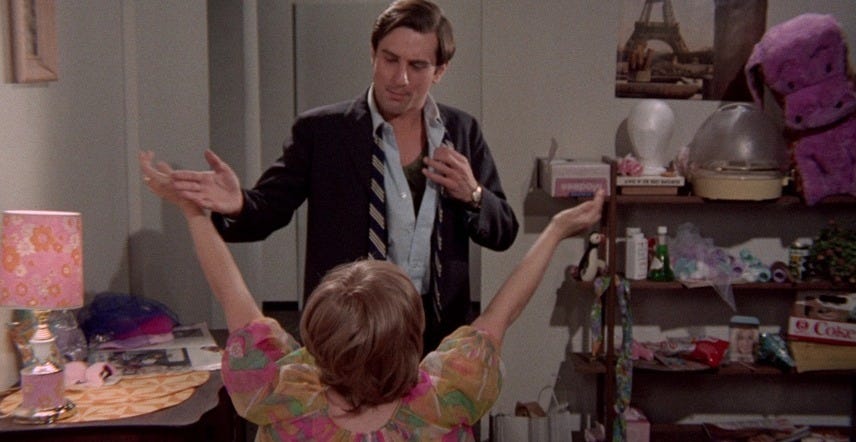
Jon’s plan, as he explains to Banner, is to seduce a young woman in the apartment across the street: Judy Bishop (Jennifer Salt). After fabricating a bogus excuse to cross paths with her, the two share a date that feels lifted out of a rom-com (save for Jon punching a pizza), and by the time the second date rolls around, Judy is throwing herself at Jon, who has timed his camera across the street to catch their throes of passion. As limbs fly in an equally comedic frenzy, unbeknownst to Jon, his camera suddenly tilts below, leaving their romp only a memory. That doesn’t work for Banner, who immediately sends Jon packing.
While this only gets us to the first half of the film, Hi, Mom! has already been racing through different versions of what it means to watch. Initially, it’s through windows, telescopes, and viewfinders, until De Palma broadens the scope to include television and documentaries. What’s the first thing that Jon does after giving up on his pornographer aspirations? He sells his camera for a television set. Observe and absorb, over and over, until every act of looking becomes another performance.
Until this point, De Palma has allowed us to watch from a safe distance. Then, we arrive at the film’s radical centerpiece, Be Black, Baby, which runs towards us to close the gap. Already, Hi, Mom! has been building to this sequence, peppering the film with flyers for a local experimental theater troupe’s production. We even get a documentary, cinéma vérité style, featuring the troupe — led by Black performers and one white university student — asking white passersby if they know what it’s like to “be Black in America.”
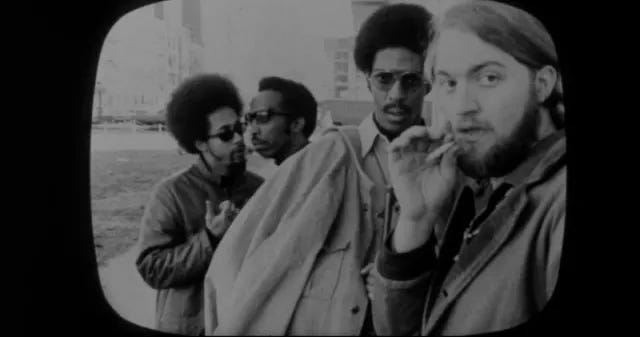
Once Jon spots an advertisement seeking an actor to play a racist cop in the production, he decides to try his luck. A hilarious audition scene follows (featuring De Niro aggressively slapping around a broom), and before long, we’re plunged into the third part of the documentary, dubbed “The Theatre of Revolt.” Without giving too much away, it’s a sequence that dismantles the comfortable distance between performer and audience. Suddenly, De Palma’s game snaps into focus: everybody is watching somebody. Jon watches his neighbors, the audience watches the performance, the documentary crew watches the audience, the television viewers watch the documentary — and we watch all of it. For a film that seems allergic to adopting a cohesive plot, Hi, Mom! keeps returning to the same uncomfortable idea: once everything becomes performance, is anyone still just watching?
Perhaps most disturbing of all is that, after the Be Black, Baby sequence ends, the film decides to bring back its Cheshire cat grin with full force. The playful “normalcy” it adopts again is De Palma’s final sleight of hand, because nothing has actually been resolved. The laughter returns, the jaunty music returns, and eventually even Jon’s grin returns. But ours? Ours has changed, leaving us to question not just what we’ve been watching, but why we were so eager to watch in the first place.
You can purchase Hi, Mom! via Radiance, MVD Shop, or B&N.
Solo (Jean-Pierre Mocky; 1970)
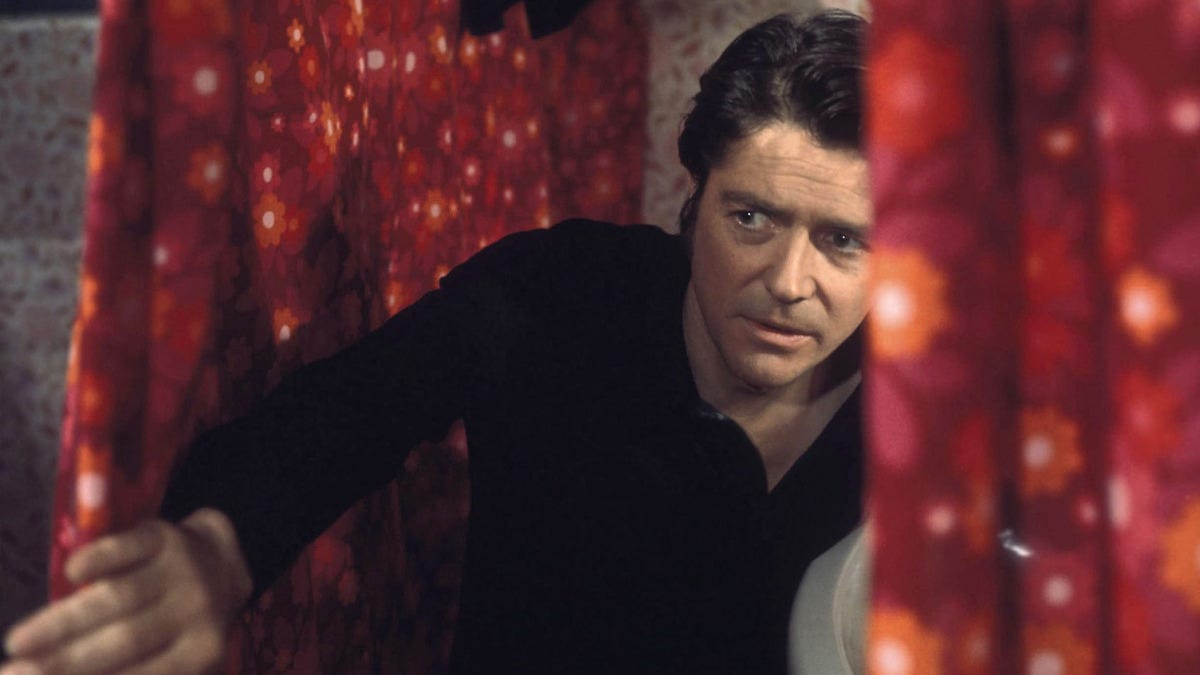
Vincent Cabral spends the opening of Jean-Pierre Mocky’s Solo behaving as though history is something that happens to other people. Joke’s on him, of course. The 1970 film begins almost like a caper, introducing us to Vincent (played by Mocky himself) as an incredibly charming violinist and jewel thief who smuggles diamonds inside a tube of toothpaste, transfers them in his instrument case, and drifts through life with an effortless confidence. It’s easy to get swept up in his spell, as he whistles, flirts, steals, and seems entirely unconcerned with the political unrest that’s still simmering as he returns to France. It’s an intoxicating introduction, and one that makes Vincent feel like someone who’s unknowingly wandered in from an entirely different movie. After the massacre of a bourgeois orgy in the film’s opening minutes, police scramble to identify those responsible. Georges Moustaki’s melancholic score starts to play — a piece borrowed from a Greek partisan song — and Solo’s elegiac undercurrent starts to seep into your bones, just as history begins catching up to Vincent himself.
Released just two years after the events of May 1968, Solo emerges from the uncertainty left in its wake. Its subject matter proved controversial enough that Mocky organized midnight screenings at Cannes himself after the festival declined to include it. The gamble paid off.
Rather than reconstructing the student uprisings that brought France to a standstill, Mocky turns his attention to the fractured society that remained. In an interview with Cinema the same year Solo came out, Mocky explained that his goal was to “make an observation, to take stock,” describing May ‘68 as “the first spark in a frozen engine.” Vincent embodies that observation. As he shrugs and tells young revolutionary Marc (Éric Burnelli), “You want to change society. I use it.” Vincent simply wants to drift through it, exploiting its cracks without ever getting involved himself. Flippant? Perhaps, but as the film unfolds, we realize Vincent has been telling us exactly how he understands the world all along.
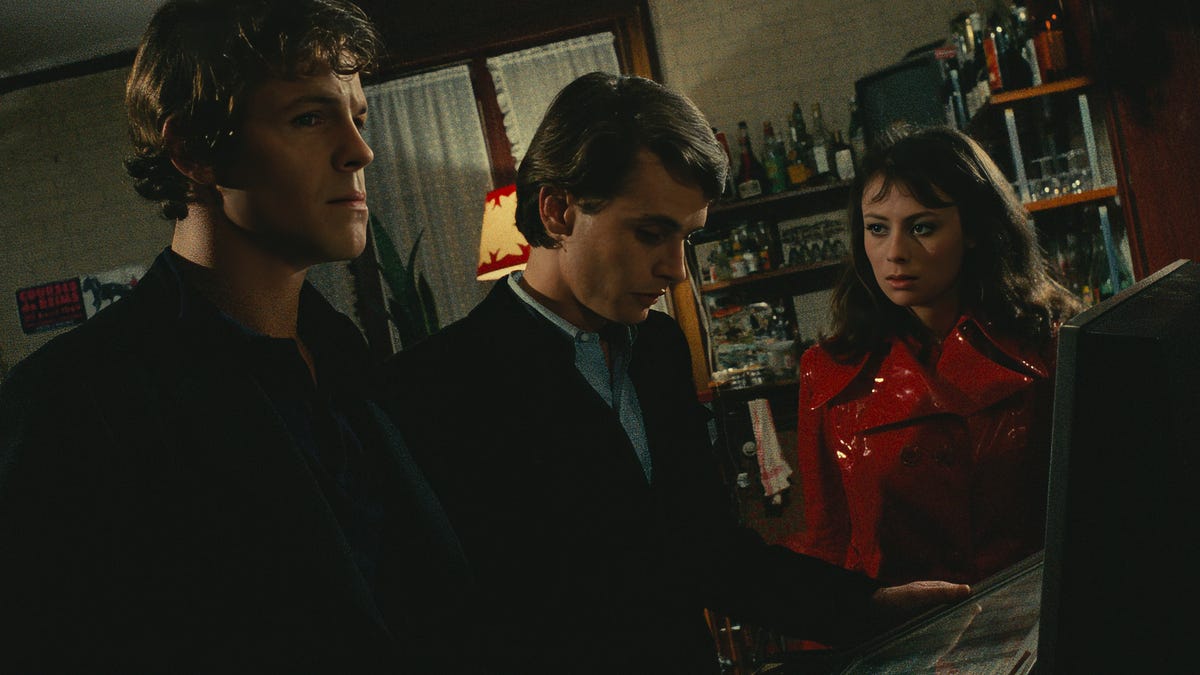
Vincent has returned from years abroad, and as soon as he sells the diamonds he’s nabbed, he’s off to find his brother, Virgile (Denis Le Guillou). With their parents out of the picture, Vincent still pays for his younger sibling’s tuition, revealing that, even for all his aimless drifting, family remains the one thing he refuses to leave behind. Virgile, however, has other plans. He and his fellow revolutionaries are responsible for the film’s opening massacre, and they’re already planning another. What makes Vincent and Virgile’s relationship so moving isn’t merely that they end up on opposite sides of France’s political divide (though one could argue Vincent stands on neither), but that Vincent never stops seeing Virgile as his little brother. While Virgile speaks in grandiose terms of sacrifice and society, even going as far as to say he’d kill his own brother if the cause demanded it, Vincent consistently speaks in terms of finding his brother and saving him. Even when Commissioner Verdier (Henri Poirier) mistakenly identifies Vincent as the ringleader, and even after their names are splashed across newspapers and television screens, Vincent’s goal never changes. One fights for society. One fights for one person.
Vincent belongs everywhere and nowhere. “I cannot stand this society made of hypocrisy and sordid things,” Mocky told Cinema 9 in 1970. With Solo, the filmmaker is attacking a moral rot that is much larger than any one political movement. Vincent’s journey carries him through nearly every layer of French society, crossing paths with wealthy elites, university students, police officers, thieves, and revolutionaries alike — yet he never fully belongs to any of these worlds. It’s here that Mocky’s description of Solo as an “observation” really clicks. Wherever Vincent wanders, hypocrisy follows. The bourgeoisie grossly indulge themselves, never once thinking of the consequences. The police eagerly pursue the wrong suspect, only to meet the truth with little more than a shrug. As for the revolutionaries, well, the cause comes before anything else — even their own. It’s precisely because Vincent never fully belongs to any of these worlds that he never loses sight of the people inside them.
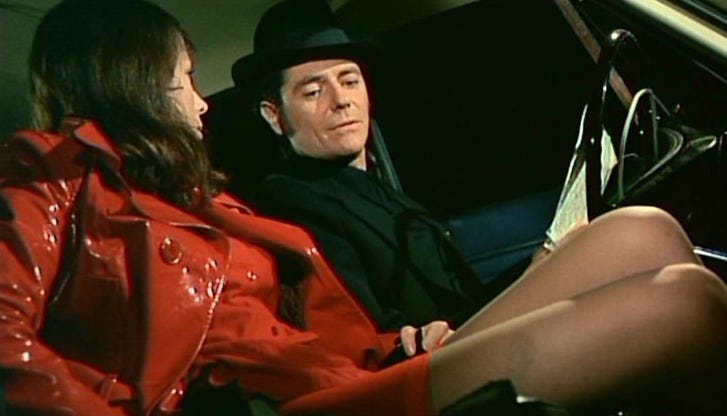
Of course, as the film continues, Vincent’s laissez-faire attitude cannot carry him for much longer. When one young revolutionary bleeds out from the crossfire, the spell finally breaks. Ultimately, what our lead spends the majority of the film doing is repair work. He steals cars to help others escape, calls ambulances instead of abandoning the wounded, and repeatedly improvises his way through increasingly desperate situations, including one wonderfully tense roadblock sequence. History has finally caught up with Vincent. Drifting is no longer enough.
I’ve thought a lot about the film’s title ever since the credits rolled. It proves more heartbreaking than it first appears. Vincent spends the film performing alone and drifting alone, all while trying not to lose the one person who still anchors him to the world. But maybe the title is tragic because Vincent never learns to live another way. Every act of rescue and survival becomes a solo. Performing against the orchestra of history, Vincent never stops trying to carry its weight by himself.
You can purchase Solo via Radiance, MVD Shop, or B&N.
Illustrious Corpses (Francesco Rosi; 1976)
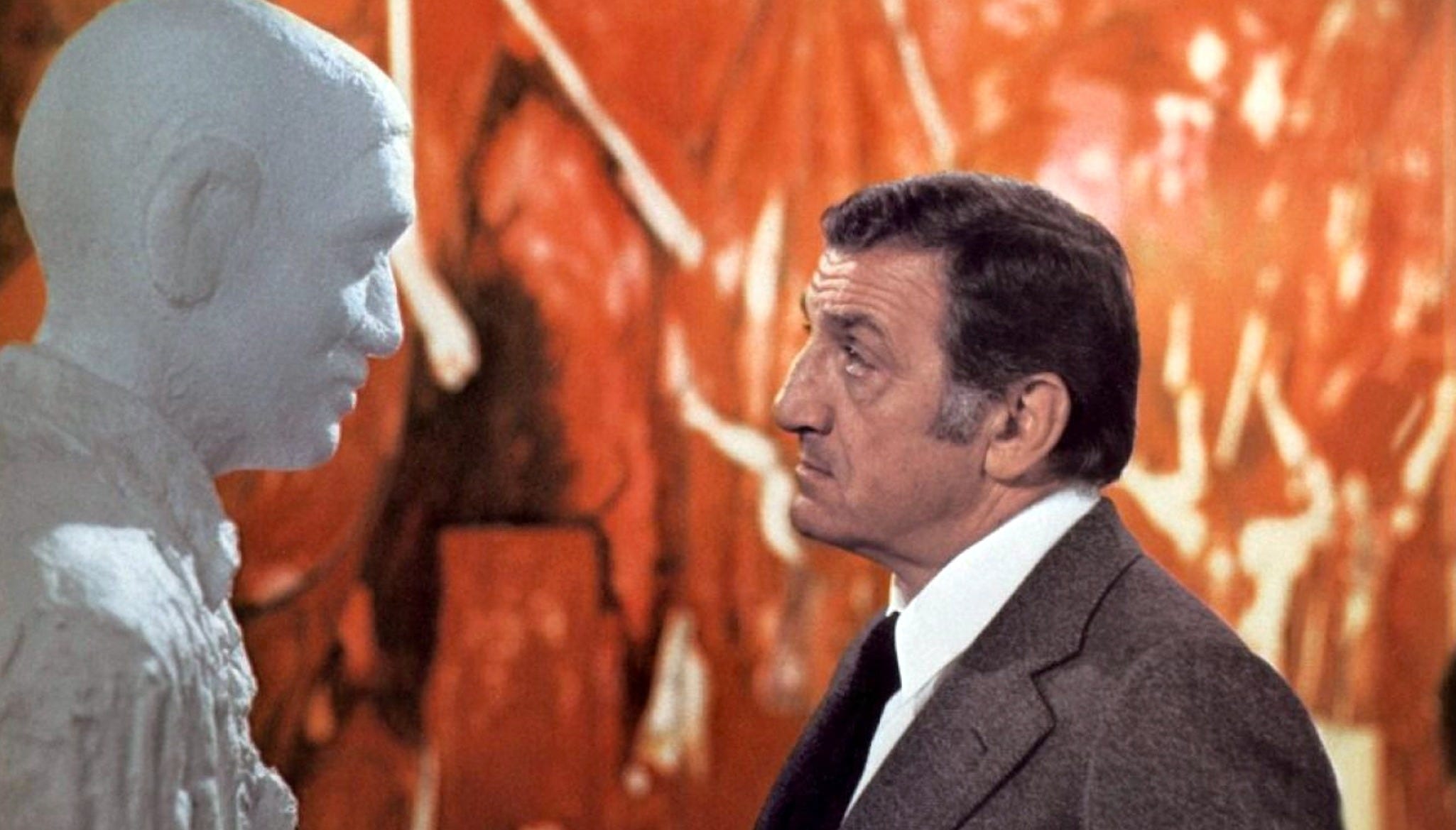
Early on in Inspector Rogas’ (Lino Ventura) investigation surrounding the string of murders targeting a handful of Supreme Court judges in southern Italy, he speaks to a man he initially believes may be a suspect. “How goes it?” the ever-calm Rogas asks — a perfectly ordinary social question. “It doesn’t,” the man succinctly replies, causing Rogas to probe further and ask what’s wrong. “Everything,” the man says bluntly. “How about before?” Rogas continues, thinking it’s a recent crisis. The man, confused, doesn’t understand the question. “Did it go well before?” Rogas asks again, to a simple “no” in response. “So?”
“So here we are.”
In Francesco Rosi’s Illustrious Corpses, every conversation is another little diagnostic test. As Rogas digs deeper, each encounter asks the same question: How healthy is this society? The answer rarely changes. Not very. Casual exchanges carry the weight of institutional decay, and before the conspiracy even comes into focus, we’re introduced to a country that already sounds tired. Rogas, however, still believes that careful investigation can cut through the fog. As clues multiply and the suspects never quite fit, we slowly realize this detective tale refuses the traditional detective story comforts. The answers Rogas uncovers only seem to generate new questions, until even his faith in the very institutions he once trusted begins to erode.
Italy itself feels similarly adrift. Caught between a conservative government led by the Christian Democrats, a rising left, and escalating violence, truth had become increasingly difficult to locate. As Rogas discovers, secrecy is one of the ways this system preserves itself. “I am opposed to the politics of secrets,” Rosi told Jeune cinéma in 1976, shortly after the film’s release. Judges, politicians, police officers, and party leaders all seem to know something, yet no one is willing to say enough. Compartmentalized truths keep the machinery running. It’s hardly surprising, then, that the director told Paese Sera that same year that the audience’s journey was one “alongside a policeman who initially believes in the institutions and the State as they are, and by the end no longer does.”
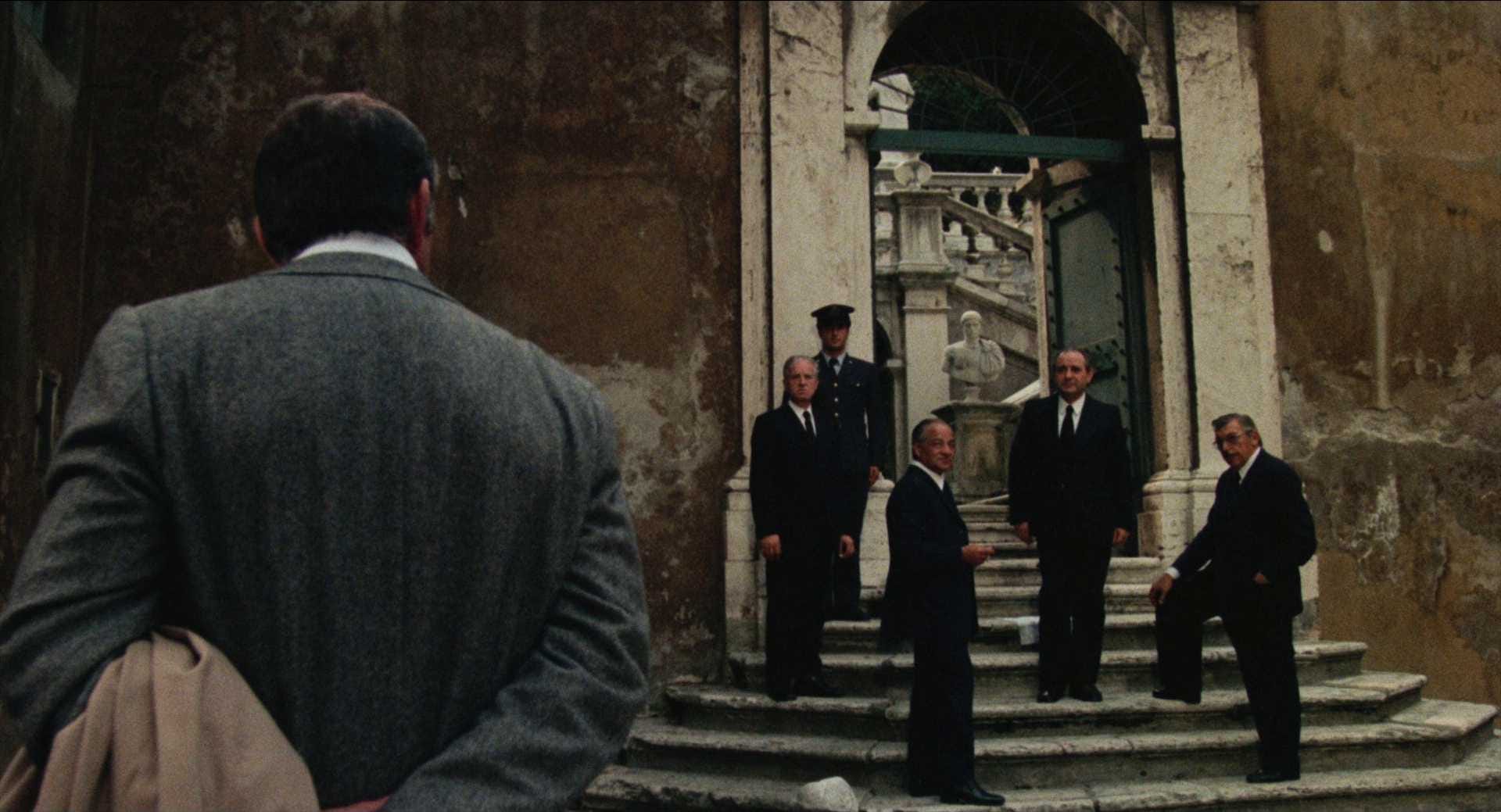
By this point, the film’s architecture speaks as loudly as its characters. Be it the vast government buildings, the shadowy catacombs, empty town squares, or endless rows of apartment buildings, the locations are tremendously imposing and labyrinthine — indifferent to the lone man wandering through them. Pasqualino De Santis’ camera swirls and pans, never letting us forget that someone is always watching. Everything decisive happens behind closed doors. When Rogas arrives, the decisions have already been made elsewhere. “It’s the mechanism of power that pushes people aside,” Rosi told Paese Sera. No wonder Rogas gradually shrinks inside the frames he occupies.
Whether Rogas solves the mystery ultimately matters less than what the investigation takes from him. What Rogas loses is his belief that institutions are capable of delivering justice. And yet, Rosi isn’t a pessimist. His plea is to keep asking questions. Fifty years later, that’s still the challenge Illustrious Corpses leaves behind. “We have to find a way out through truth.”